
I first became familiar with NorthLight Arts Centre in the summer of 2024.
A good friend of mine told me about an upcoming exhibition called Savour, which explored the influence of hip-hop across different art forms. He was also running a monthly event called The Dry Spot — a real melting pot of roller boogie, Jamaican food, an outdoor barbecue and open decks for anyone who wanted the opportunity to showcase their talent.
On my first visit, I was genuinely impressed by what had been done with the building. The premises had previously been a well-known pub, The Shoulder of Mutton, and occupied a particularly interesting position in Leeds, with Chapeltown on one side and Chapel Allerton on the other — two vibrant, multicultural and diverse communities. It seemed to me to be the perfect location for a community arts centre.
The more I visited NorthLight Arts Centre, the more familiar I became with the people behind the bar and those involved with the CIC.
One Sunday afternoon, I was invited to an impromptu gathering in the gardens. At that time, the outdoor space was beautiful: picnic benches, an open fire pit, a play area for children and a large green space surrounded by some of the most impressive graffiti I had seen in a long time. It felt alive. It felt creative.
More importantly, it felt like somewhere that could genuinely bring people together.
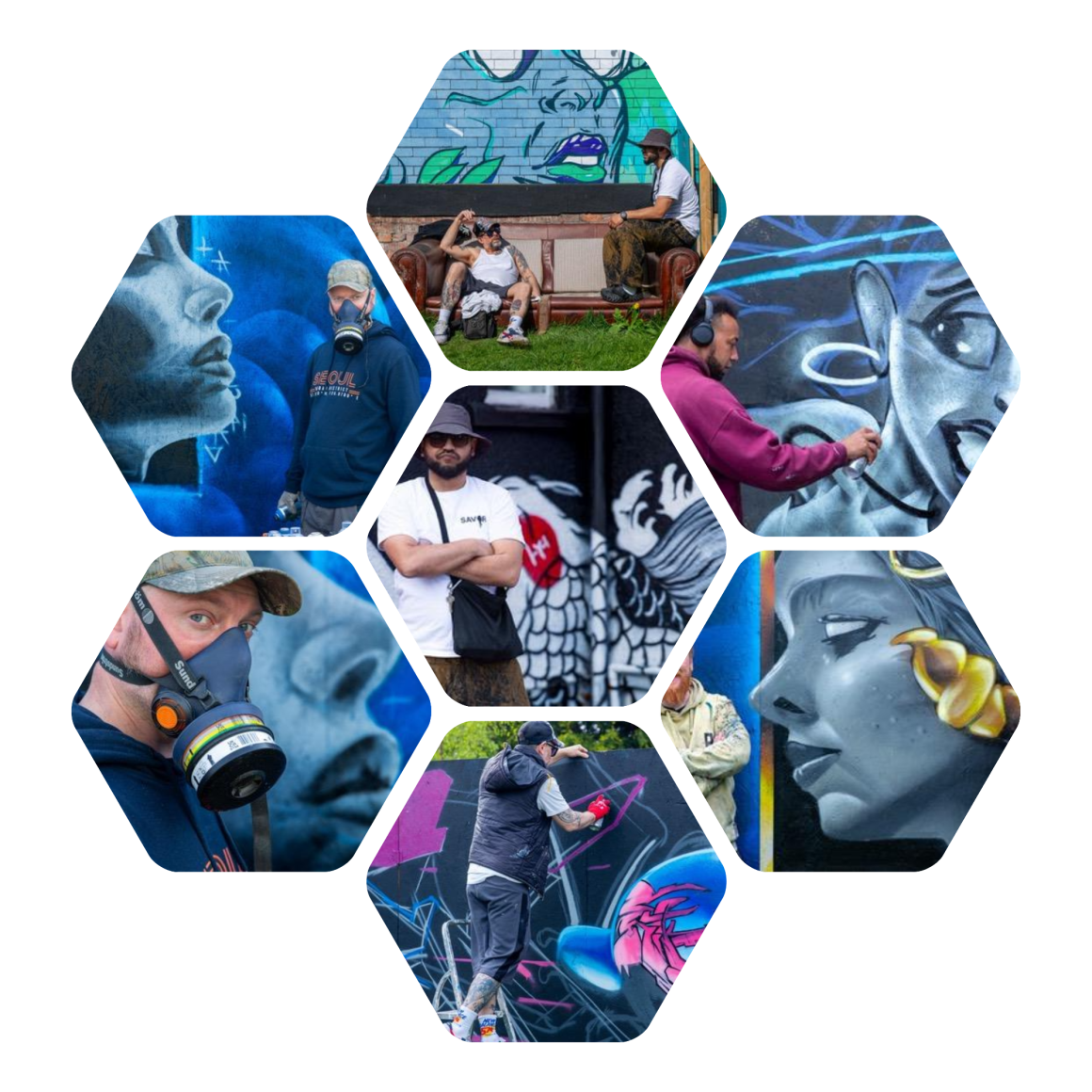
Image: In the garden at Northlight. Art by Marcus ‘Hyro’ Brown. From this, a vibrant community space…..
It was during that gathering that I had the pleasure of meeting Paul Simon, one of the two founders, and Simon SB, a local artist who used the facilities to showcase his work while also working there in the coffee shop during the day and the bar in the evenings.
Paul took the time to give me a full tour of NorthLight Arts Centre. He spoke passionately about the artists who used the building, its history and the enormous amount of work that had gone into transforming the former pub into a space that could be enjoyed by the wider community.
One part of the building that particularly interested me was the kitchen. This was not simply an old pub kitchen that had been tidied up and put back into use. Paul had built the kitchen from scratch as part of the redevelopment of the premises. Considerable work had gone into creating a proper working food preparation space. The finished kitchen had been surveyed and had passed the necessary health and safety requirements. It had also achieved a five-star food hygiene rating. That is important because it meant NorthLight Arts Centre already possessed something that many community venues would love to have: a properly equipped and approved kitchen capable of supporting food-based events. To me, the possibilities were obvious.
We talked at length about the events already taking place and, more importantly, the enormous potential of the building.
Cultural food nights seemed like an obvious opportunity. Chapeltown and the surrounding areas have an extraordinary variety of cultures, cuisines and communities. Why not invite people into NorthLight Arts Centre to share those cultures through food? There could have been Caribbean nights, African food events, Asian cuisine, community cook-ups or evenings combining food with music and art.
It didn’t have to stop there. We talked about comedy nights and family events. We discussed making the building available for birthdays, anniversaries and other celebrations — somewhere local families could use when their own homes simply weren’t large enough for all their guests. The garden meant children could have space outside. The kitchen meant food could be prepared properly. Paul had also refurbished and equipped the cafe/bar. The various rooms provided space for art, music and entertainment. In my eyes, practically all the ingredients were already there. NorthLight Arts Centre could have become a genuine cultural hub.
When I went back to see Paul to discuss some of these ideas in more detail, however, he seemed noticeably deflated. He told me he had raised some of the suggestions with Tim, Boris and Amanda, the other members of the committee, but they had not been enthusiastic and felt they would be a waste of time and effort. It surprised me, given all the features I’ve mentioned, that ideas designedd to bring more of the surrounding community through the doors were apparently being dismissed. I couldn’t understand it.
The arts and crafts open day
One weekend, NorthLight Arts Centre was due to hold an arts and crafts open day, with artists showcasing their work on pop-up stands and stalls throughout the building and outside. Simon SB asked whether I would be willing to help him on the day. He was recovering from surgery on one of his legs and was using a walking aid. I jokingly told him: “I’ll be your legs for the day.”
Having previously worked in hospitality, I suggested that one way of increasing revenue would be to offer table service. I could take orders not only from visitors but also from the artists and vendors, who would be busy looking after their stalls and might not be able to keep leaving them whenever they wanted a coffee or something to eat. Simon thought it was a fantastic idea and was looking forward to what we hoped would be a busy day.
The Saturday morning arrived and the weather was beautiful. I got there early, asked for a pinny and a notebook, and Simon happily obliged. So off I went.
I spoke to the vendors and quickly returned with an order for six drinks. Simon seemed delighted and began preparing them. At that point, however, Amanda and Boris, committee members, appeared increasingly concerned by the fact that six drinks had been ordered at once. Having spent many years working in hospitality, I found the reaction surprising. I left them to prepare the drinks and went outside to see whether any of the other vendors wanted food or refreshments. I came back with another three orders.
Not long afterwards, Simon asked if he could have a quiet word with me outside. He told me that my presence and the number of orders I was bringing in were causing stress for Boris and Amanda. I was asked to take off the pinny, put away the notebook and stop helping. My services, apparently, were no longer required. I was slightly bemused. As far as I was concerned, I was volunteering my time, helping Simon while he recovered from surgery and trying to bring additional revenue into the cafe. I couldn’t help but laugh at the absurdity of it.
What I didn’t realise at the time was that this incident was a significant indication of my future relationship with Amanda and Boris.
On subsequent visits, I increasingly felt that I was being given the cold shoulder and made to feel unwelcome. On one occasion, I was even referred to using a deeply offensive term.
Where was the wider community?
I visited NorthLight Arts Centre again one Friday evening when The Dry Spot was taking place and was surprised by how small the crowd was. I asked Paul why there weren’t more people there. It struck me as exactly the kind of event that should have been attracting people from the surrounding neighbourhoods
Paul told me he felt there was little interest from the committee in promoting the evening events.
I decided to look at the website myself, and I was genuinely surprised by what I found. The promotion seemed heavily focused on daytime activities such as creative writing, knitting, sculpture and felt work.
There is absolutely nothing wrong with any of those activities. They all have their place. But where was everything else? Where were the activities that, in my view, reflected the cultural diversity of the communities immediately surrounding NorthLight Arts Centre? It felt like an enormous opportunity was being missed.
An “exclusive” exhibition
I later heard about another forthcoming exhibition featuring a cyclist who travelled the world photographing his adventures. As a cyclist myself, I was immediately interested and asked when the exhibition would be taking place. I was surprised to be told by Tim that it was going to be an exclusive, invitation-only event rather than something open to the public. That didn’t sit comfortably with me.
For an organisation operating as a Community Interest Company, I found myself wondering: When did this community arts space become an exclusive one?
My birthday booking
A few months later, I was approaching a milestone birthday and asked Paul whether I could book NorthLights Arts Centre for a private family celebration. He said: “Of course.” The date was put in the diary around three months in advance. The venue seemed ideal for my family and friends, young and old.
Later, when forthcoming events were apparently being discussed at a committee meeting, I was told that Amanda had questioned who the person was who wanted to use the space for a birthday party. Paul explained that it was me. Amanda, I was told, responded by saying she thought it was a bad idea.
Boris and Tim agreed. I was then told that I would need to find somewhere else to celebrate my birthday.
What made the situation even more uncomfortable was that, a few weeks later, while Paul was holding a barbecue at NorthLights Art Centre, Amanda asked me whether I had managed to find an alternative venue for my birthday. I found the question astonishing, given what had happened.
What I took from my experience
These are only some of the negative experiences I had involving Tim, Amanda and Boris, but over time they contributed to a much bigger concern for me.
From what I personally witnessed, the version of “culture” being promoted at NorthLight Arts Centre felt increasingly narrow and disconnected from the diverse communities surrounding it. The version of “art” being presented felt selective, and at times the space itself felt far less inclusive than I believed a community arts centre in that particular location ought to be. Those are strong words, and I don’t use them lightly.
But I kept asking myself the same questions:
Where were the cultural events reflecting the people of Chapeltown and the surrounding areas?
Where were the events embracing the food, music, art and traditions of the communities living virtually on the doorstep?
Why have a garden surrounded by incredible street art and not shout about it?
Why have spaces capable of hosting music, exhibitions, family events and community gatherings and then seemingly restrict the ambition for what could take place there?
For me, this was the frustrating thing about NorthLight Arts Centre. The potential wasn’t hypothetical.
Much of the infrastructure was already there. The building had all the ingredients to become something extraordinary. That is partly why, what I saw when I returned much later was so disappointing.
Returning after 18 months
On a very recent visit, I popped in to see Simon SB. I had not been inside NorthLights Arts Centre for more than 18 months.
I was shocked by the difference.
What had once included a beautiful Japanese mural had been painted over in black. To me, the building now had a sombre appearance — a far cry from the vibrant arts space I remembered.
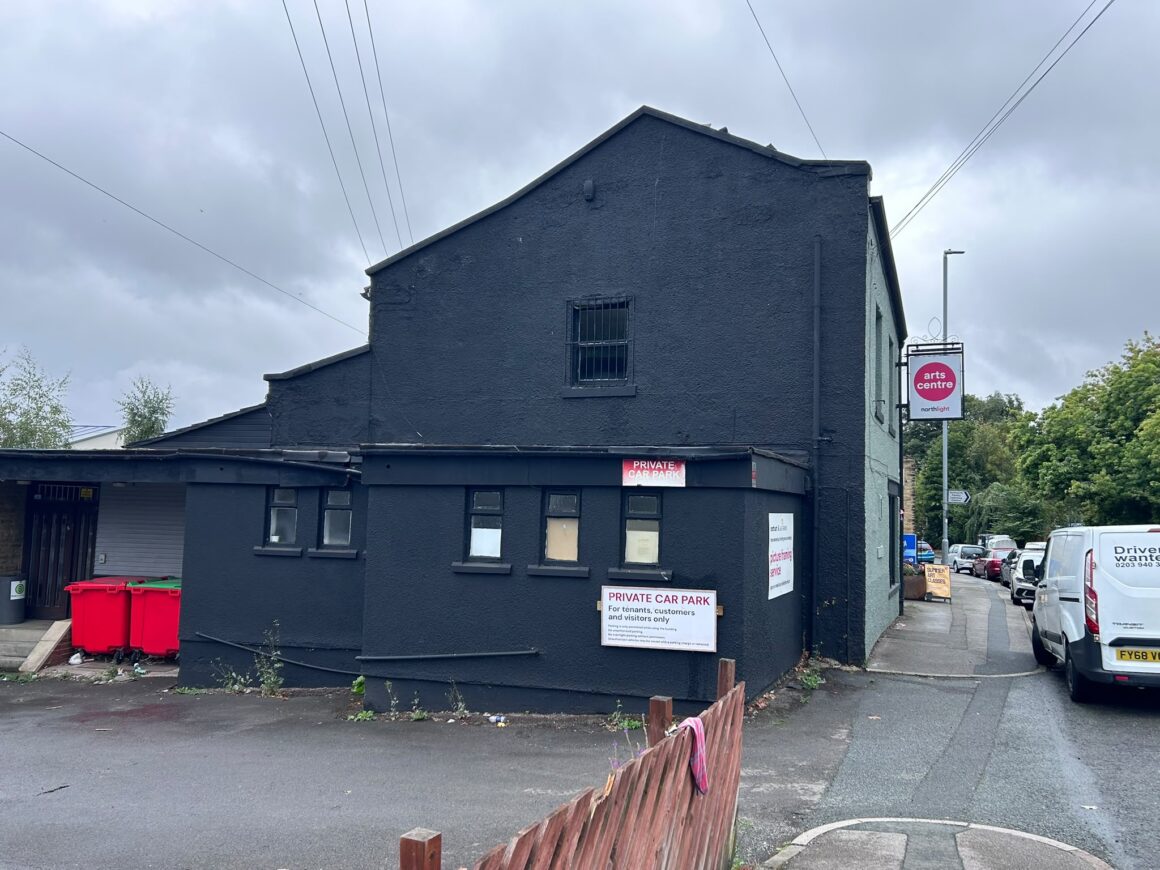
…..to this. Northlight to ‘Northdark’. Weeds, litter and broken guttering. Does this look like they care?
The doors were closed and I could see no obvious sign telling visitors whether the centre was open.
Then I looked towards what had previously been Paul’s kitchen. This was perhaps one of the saddest things for me to see.
I remembered it as a kitchen Paul had built from scratch: a genuine working facility that had been surveyed, met the relevant health and safety requirements and achieved a five-star food hygiene rating.
It had represented opportunity. It meant NorthLight Arts Centre could prepare and serve food properly. It meant cultural food evenings were possible. It meant community events, celebrations and gatherings could be catered for. Combined with the cafe, bar and garden, it had been one of the things that made the building so versatile.
Now, when I looked towards it, I saw what appeared to be a storage area. It was so cluttered that, from what I could see, I found myself wondering whether it could present a safety concern. For me, the contrast was extraordinary. Something that had been purpose-built and had once represented so much potential now appeared to have become somewhere to store things.
There was almost nobody else in the building. Apart from Simon and Amanda, the only person I saw was a man having a quick coffee. I overheard him saying he was waiting for a tyre to be changed at the business next door.
Simon and I went outside for a coffee and a catch-up. Again, I could hardly believe the transformation.
The outdoor space that I remembered as colourful, welcoming and full of character now looked, to me, more like a building site. Much of the art had gone. Areas had been painted black. The graffiti boards I remembered were no longer there. The whole place seemed to have lost much of the personality that had originally drawn me to it.
Simon and I sat talking for around two hours. It was a beautiful day. During that entire time, on a Friday in August, I did not see another visitor come into NorthLight Arts Centre. For a venue situated between such vibrant communities, that seemed incredibly sad.
And then came the irony. Sitting outside was a large sign bearing the words: “All you need is love.”
Given everything I had experienced, I couldn’t help but laugh out loud. Because for me, the problem was never NorthLight Arts Centre itself. I loved what the place could have been. I saw its potential from the first time I walked through the doors. The problem, from my perspective, was what appeared to be happening to that potential. The premises seemed to have become narrower rather than broader; quieter rather than busier; and less welcoming rather than more inclusive.
NorthLight Arts Centre didn’t lack potential. It had it in abundance. What it appeared to lack was the willingness to use that potential to embrace the full community sitting right outside its doors. And that, more than anything, is what I find disappointing.
Tauf. August 2026
Main image: art by artist Marcus ‘Hyro’ Brown.