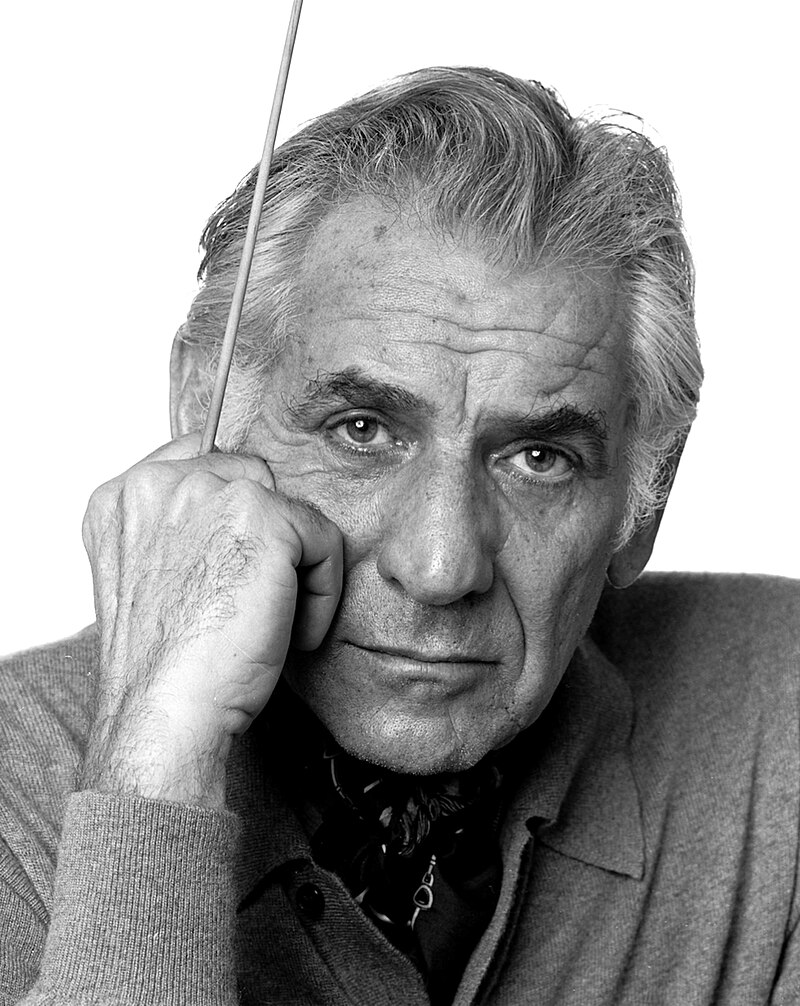
Leonard Bernstein stirred strong passions in concert halls and in his life generally.
You will know this if you watched Maestro, the biographical film about him on Netflix a couple of years ago. The actor playing the great composer-conductor (Bradley Cooper) threw himself around energetically to give us a good idea of what an American musical genius is like. If you did not see the film, I assume hopefully that you have experienced West Side Story, inspired by Shakespeare’s Romeo and Juliet and created in collaboration with Stephen Sondheim. You might hear distinct echoes of its music in Bernstein’s Chichester Psalms.
The three movements of this head the programme at the latest concert given by Leeds Festival Chorus on 22 November. The work was commissioned for a festival at the Anglican Chichester Cathedral in 1965, though it was first performed at the Philharmonic Hall in New York two weeks before its performance in Chichester. It has since become a popular part of the repertoire of choirs everywhere, particularly in Britain, and is known to be difficult but exciting. Most of the difficulty is because the words of the psalms are in their original language of Hebrew, which singers must learn to pronounce before they can sing them properly. This acknowledgement of origins (and identity) makes any concert which includes the psalms a celebration of both Jewish and Christian traditions to some extent, though you do not have to be religious to appreciate the power of the music.
This is exuberant to the point of riotous in places, simply sentimental and idyllic in others. The first movement, mainly made up of Psalm 100, is dominated by a feeling of joy, communicated in irregular metres of 7/4 and 10/4. In the English version of the time of King James the First, the words begin ‘Make a joyful noise unto the Lord of all ye lands’ but here they begin ‘Hariu l’Adonai kol haaretz’, helpfully rendered in an alphabet readable by most singers. Psalm 23 is featured in the second movement. This psalm, often chosen for Christian funerals, is suitably slow and lyrical, but is contrasted with the wild anger of Psalm 2, which begins with ‘Lama rag’shu goyim’ – ‘Why do the nations rage?’. The final part of the sequence comes with verse one of Psalm 133, which is about brethren living ‘gam yahad’ or ‘together in unity’. It is beautifully serene.
Hungarian Zoltan Kodaly’s Missa Breva, first composed in 1942, is notable for the inspiration he gained from the folk melodies of his country, which he incorporated into the sacred elements. He transformed this initial version into one for chorus and orchestra in 1944 while he was sheltering in the cellars of the Budapest Opera House, when the city was being besieged by the Soviet Red Army. The third sacred choral piece in the programme is Johann Sebastian Bach’s ‘Lobet den Herrn, alle Heiden’ (‘Praise the Lord, all ye Gentiles’) a motet which is also based on a psalm, number 117. It is full of joy and fugal energy.
The Chorus is currently marking an amazing fifty years since Simon Wright first became its conductor and artistic director, which is a lot longer than most others. He has guided and inspired its members in Britain and on foreign tours to countries like Poland, Italy and most recently Spain, not only with his supreme musical skills and knowledge but with his constant good humour and accessibility. This concert may not be your last chance to see him in action, but he intends to retire soon. The venue is St Edmund’s church in Roundhay, which the Chorus uses instead of its historic spiritual home, Leeds Town Hall. This is still being restored, interminably it seems. The church holds considerably fewer people, so it might be a good idea to book now on the Chorus website.
Getting to St Edmunds
St Edmund’s is a relatively new Anglican church established in Roundhay at the beginning of the last century. It is within the Diocese of Leeds and the Allerton Deanery.
Lidgett Park Road
Leeds
LS8 1JN
Main image Simon Wright in rehearsal.