La Bohème is usually a sure-fire bet for theatre companies around the world, a supremely popular opera with everlasting themes of young love, loss and grief driven by Giacomo Puccini’s extraordinary music.
The plot was picked out of a sprawling mass of stories assembled by the novelist Henri Murger in the mid-nineteenth century. It generally mythologized bohemian life, the famous Latin Quarter of Paris and
exploited, poverty-stricken seamstresses.
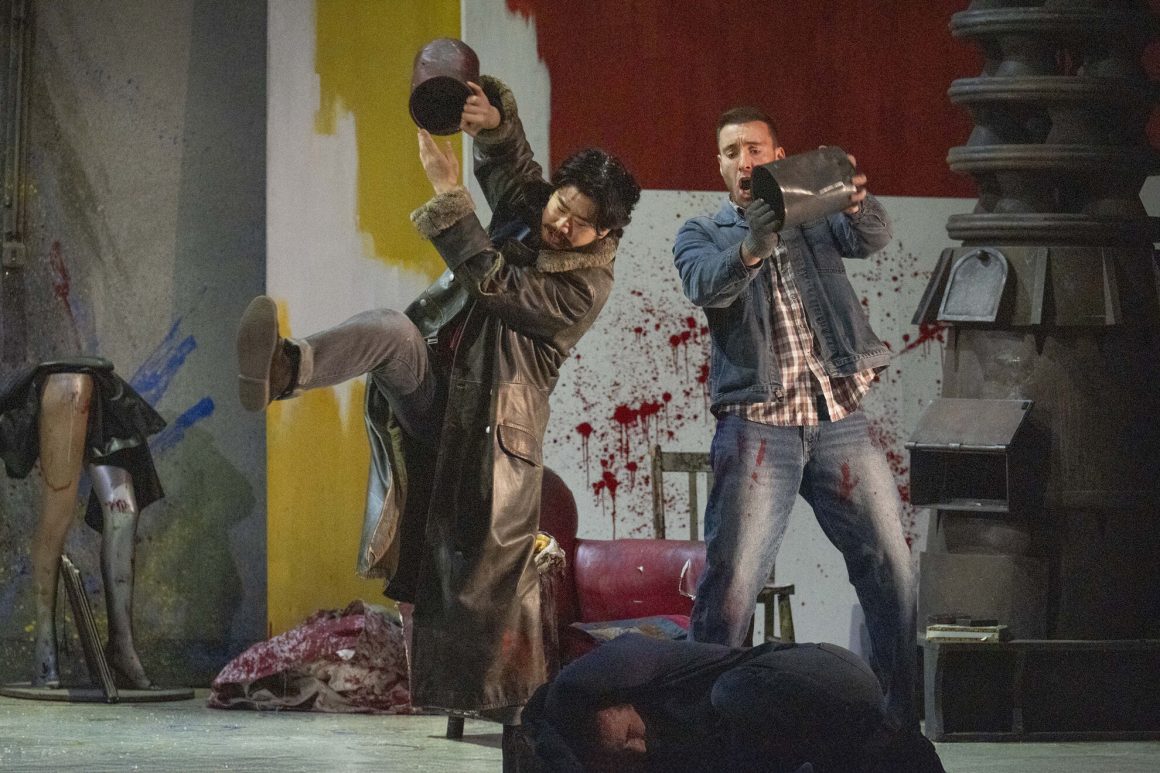
This radical production at Leeds Grand Theatre is almost everlasting as well, because it was created by the legendary Phyllida Lloyd in 1993, who updated the action to the 1950s. I last saw it at the Grand in 2019, when the set and costumes were about the same, and the singing terrific. This time around, with James Hurley as revival director, it was a few notches up from that, a dynamic show in the original Italian with English translations on screens to the sides of the Grand’s proscenium arch.
Anthony Ciaramitaro as Rodolfo and Han Kim as Colline
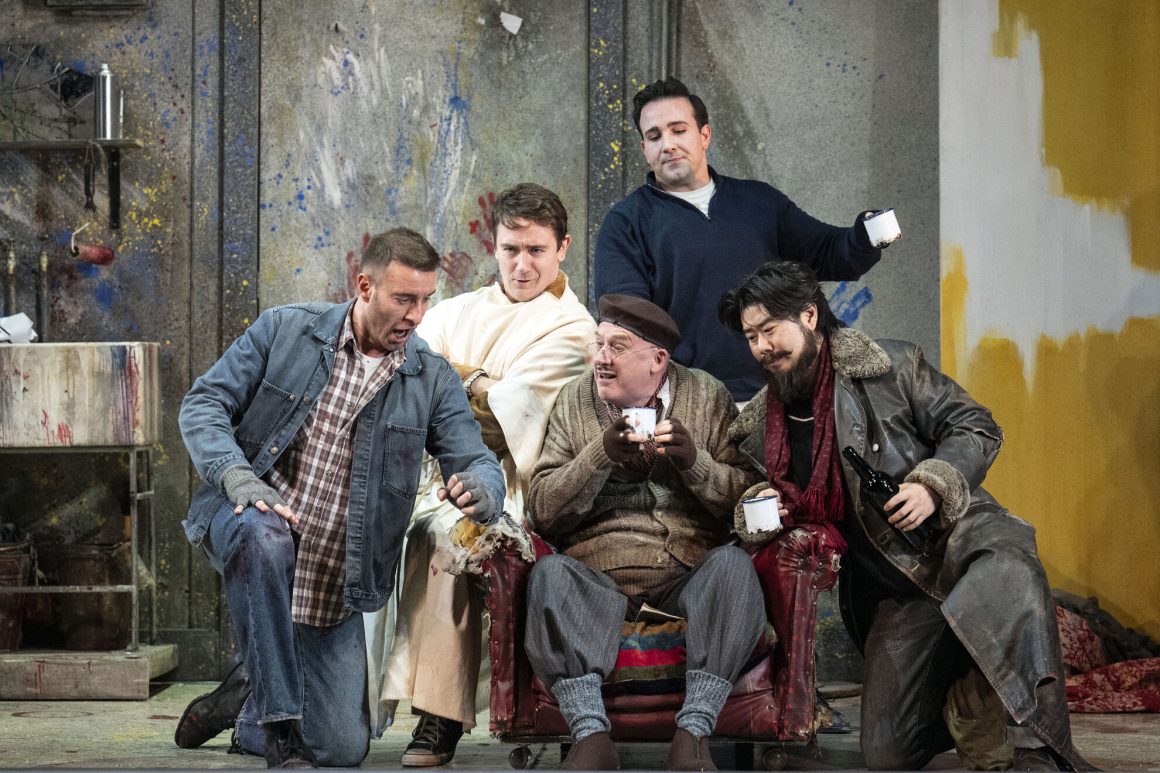
To refresh your memory of the bare bones of a relatively straightforward story, it is about four struggling bohemians – a poet, a painter, a musician and a philosopher. They live together, shivering and slapsticking around in a starkly bare, freezing cold room in Paris just before Christmas, and they are all male; this is more than one and a half centuries ago, so their female versions either did not exist or did not get written about.
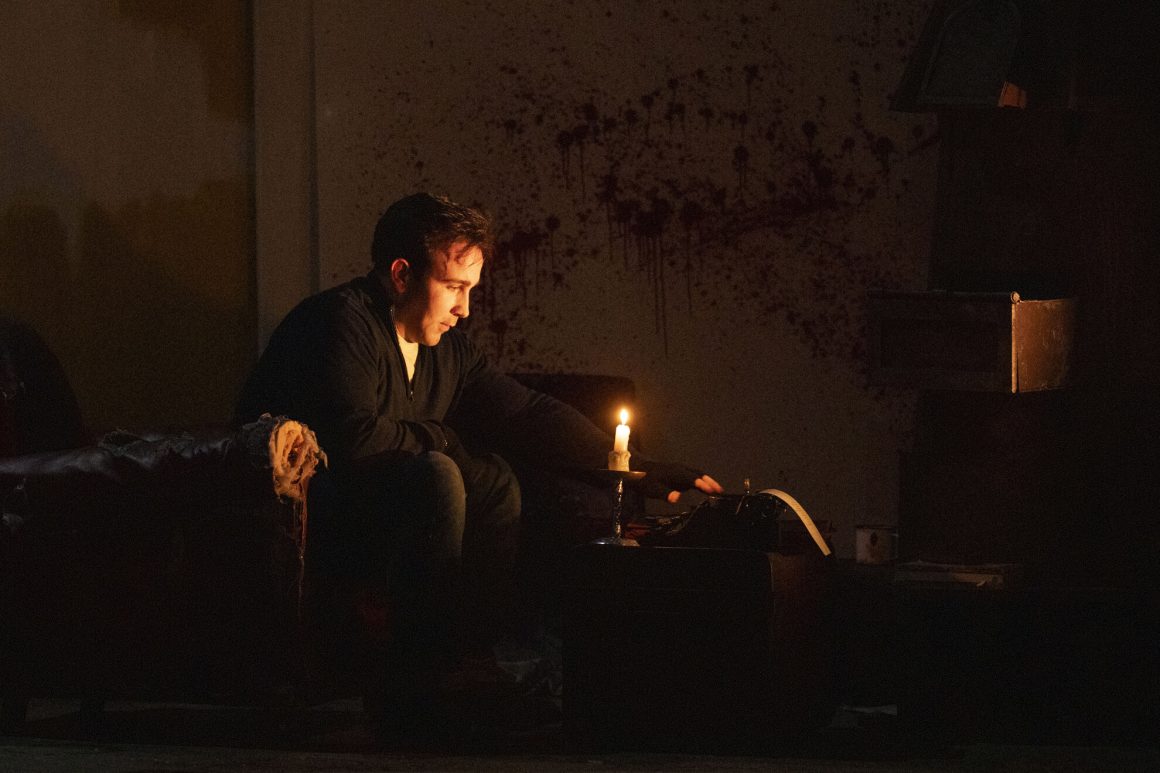
A knock on the door changes everything. It is a girl from upstairs, the waif-like seamstress Mimi, who has run out of matches and wants a light for her candle. She falls to the floor in a faint. Rodolfo, a ‘struggling poet’, quickly falls in love with her, but that fainting fit should have warned him (and the audience) that she is dangerously ill, and he soon realises that he cannot raise the funds to provide for her. Together with his companions, Marcello, Schaunard and Colline, he can cope with harsh realities through humour and a sense of comradeship, but despair is always lurking. It is what grabs both Rodolfo and Mimi as their relationship progresses, though their love remains. Mimi never becomes bitter, but takes on angelic qualities when she decides not to be a drag on Rodolfo and to leave the relationship, which gives her an unusual amount of agency in the operatic gallery of doomed heroines. She makes difficult choices rather than just waiting for her fate.
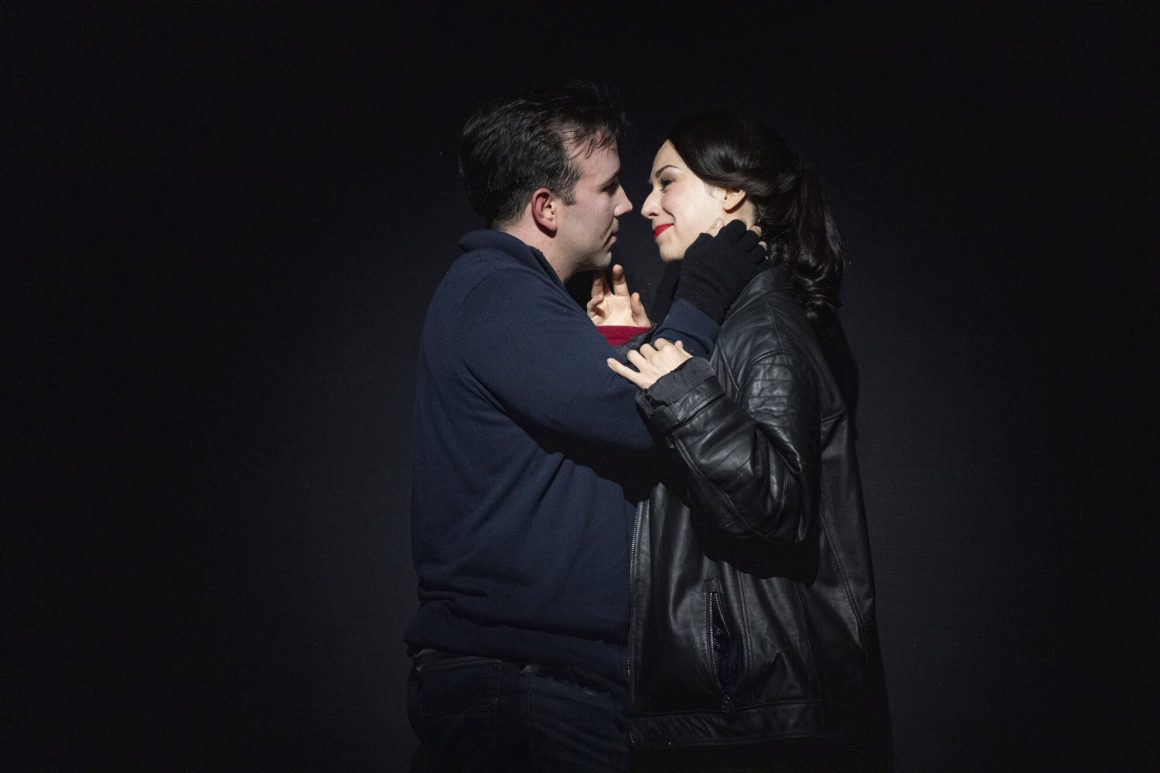
In this recreated world of the 1950s, Mimi is a bit of an existentialist dressed in black, Marcello produces multiple prints of Musetta, his beloved, in the style of Andy Warhol and owns a motorbike, bringing Marlon Brando in the 1953 film ‘The Wild One’ to mind. Soprano Olivia Boen was the soul of tenderness as Mimi, conveying the physical fragility of her character with great credibility and a powerful sense of her
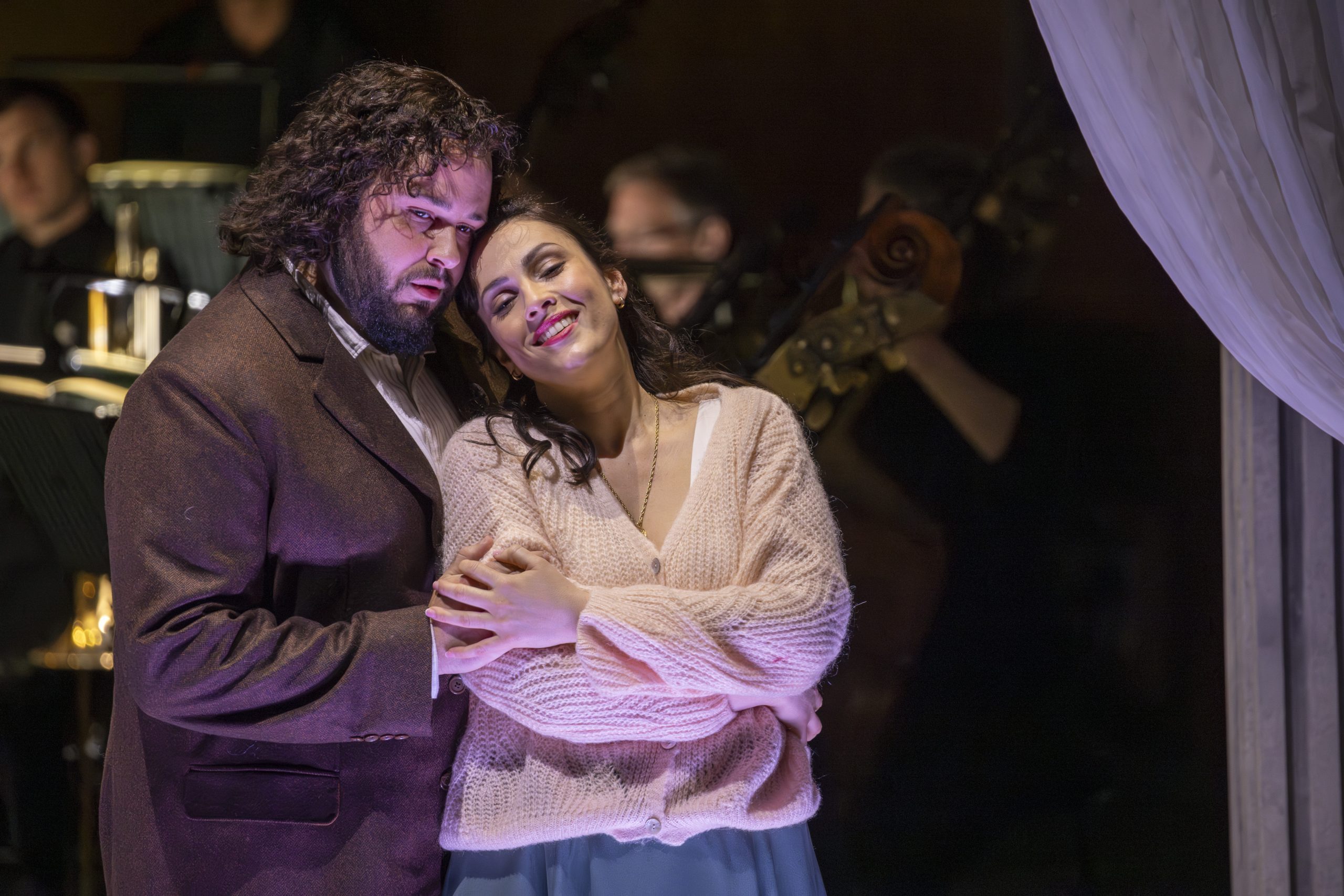
inner strength, with deep emotions in her voice. Every high note was reached effortlessly. This was all immediately apparent in Act One when with lyric tenor Anthony Ciaramitaro as Rodolfo she delivered a superb Si mi chiamano Mimi (They call me Mimi) and Che gelida manina (What a cold little hand). Ciaramitaro was sensational, from the moment he offered to burn the manuscript of the play he had written for extra warmth in Act One, to his last notes as he hugged the dead Mimi at the end of Act Four.
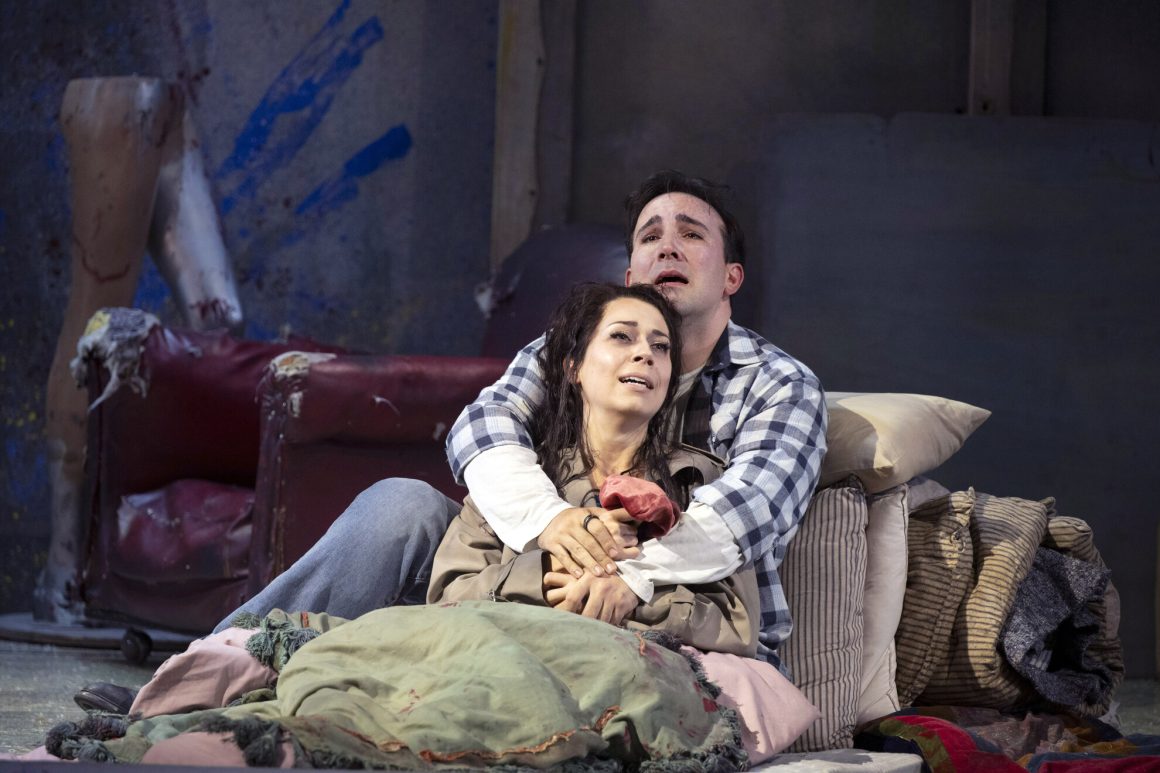
I hesitate to compare him with the historic tenors who have recorded arias from this opera (Caruso, Gigli, Pavarotti) but believe me, he came close. His upper register was never strained and he had the skill to move from confident stridency to gentle lovey-doveyness with ease, without over-emphasising the sob style of singing, often accompanied by gesturing, which must seem normal for an Italian performer.
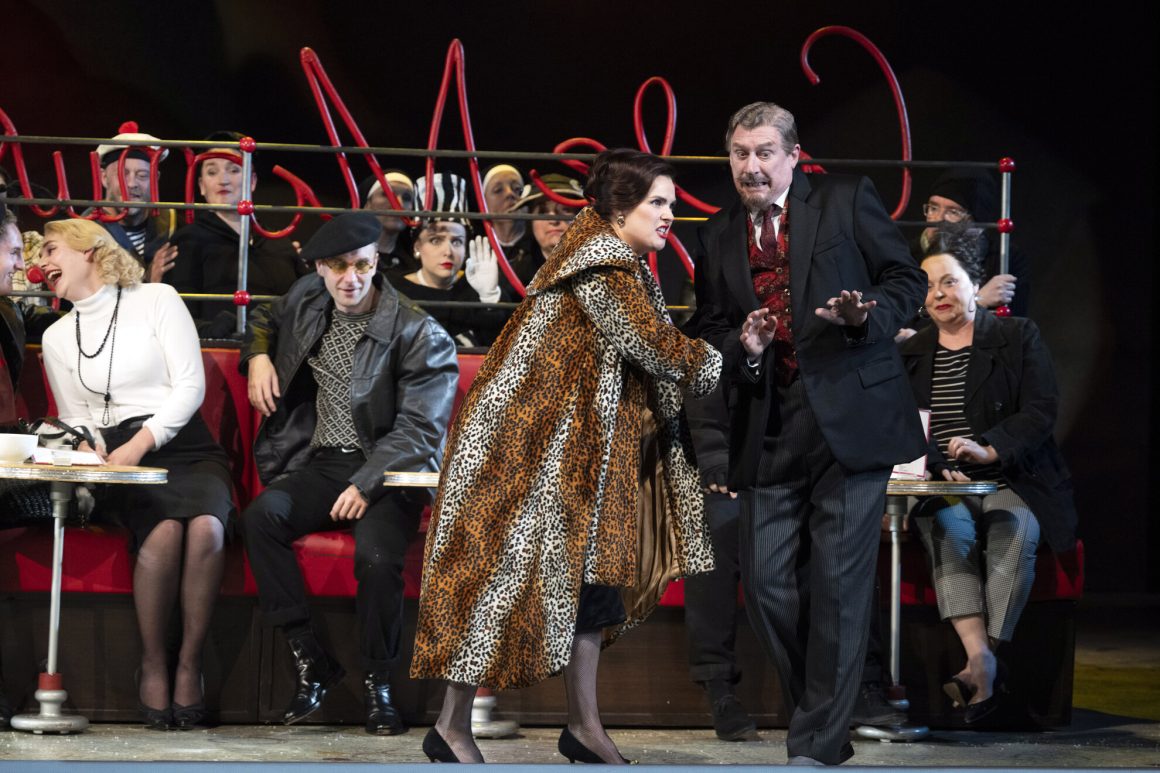
Chorus of Opera North
Baritone Yuriy Yurchuk as Marcello had a forceful lyrical presence, his rich voice complementing that of soprano Elin Pritchard very well. She played his flirty and dramatic lover Musetta, and was impressive as she manipulated the emotions of both him and her creepy rich suitor Alcindoro in the Café Momus. Her aria Quando m’en vo (When I go out) was a tour de force as she swagger-waltzed through the café trying to get Marcello’s attention.
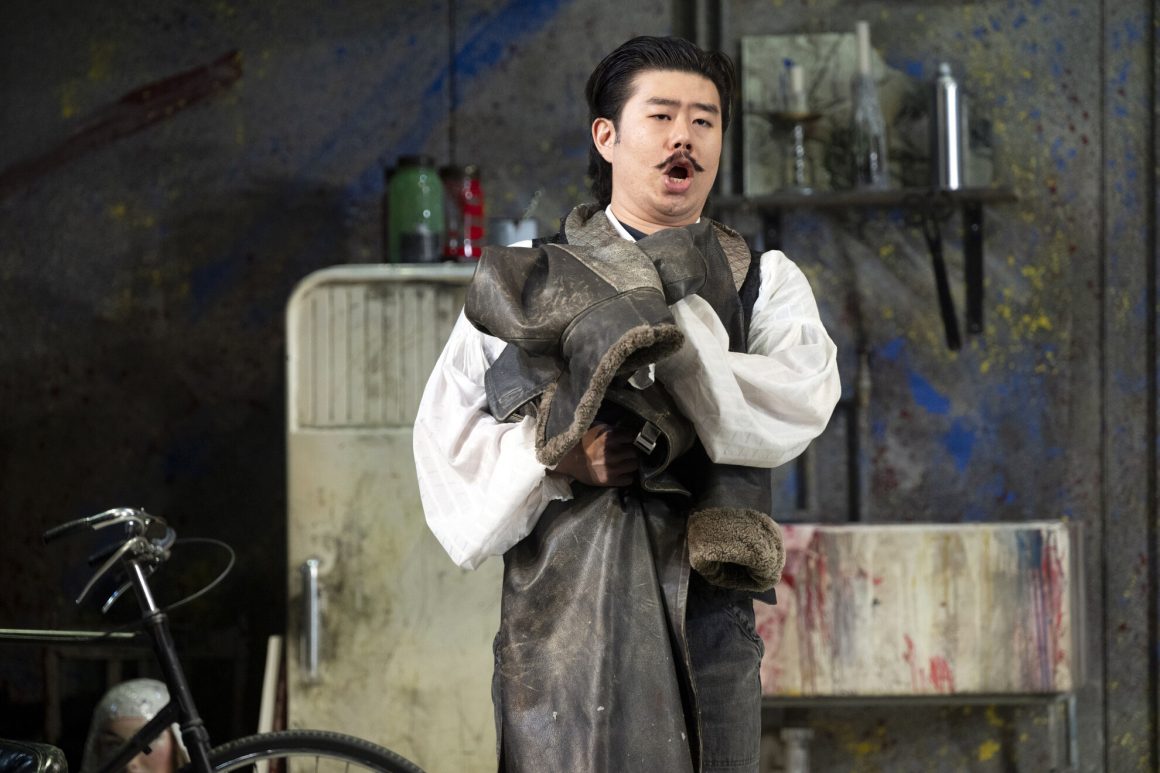
Baritone Seán Boylan projected himself with enormous panache as Schaunard and bass Han Kim as the
philosopher Colline delivered a superb rendition of Vecchia zimarra, senti (Farewell, old coat) in Act Four, when he is about to pawn it to raise funds for the dying Mimi.
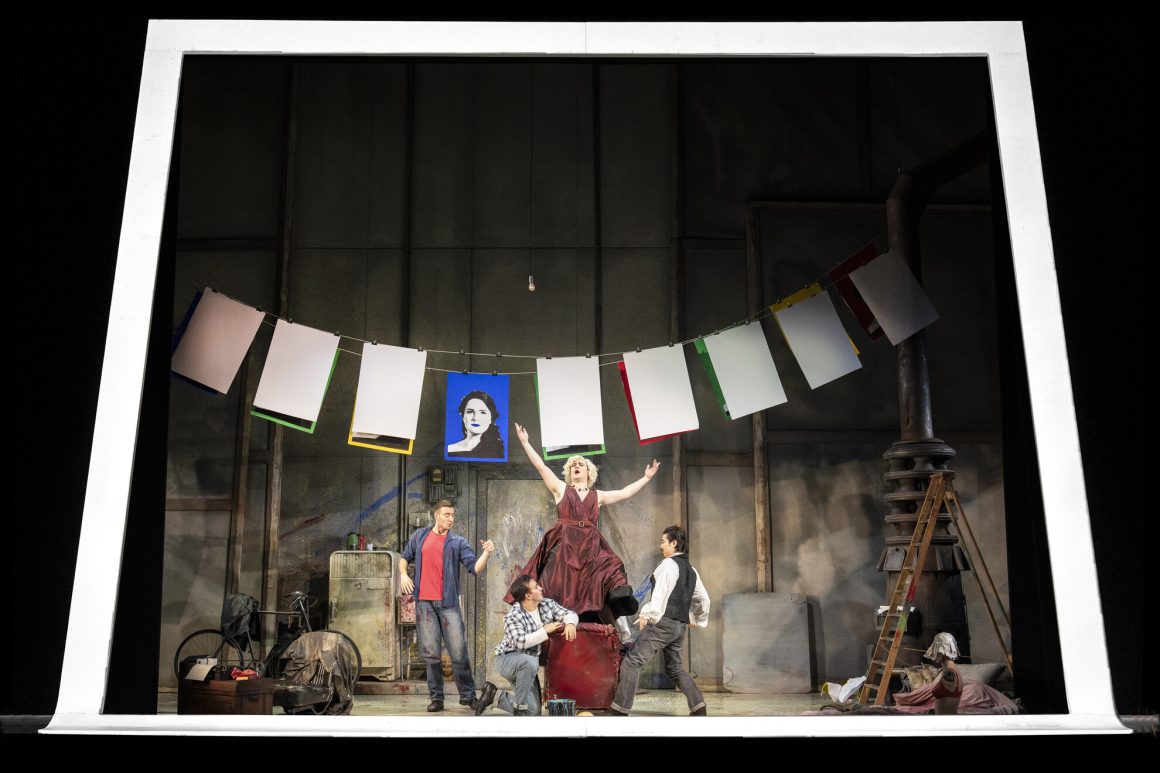
Schaunard and Han Kim as Colline
The Café scenes in Act Two were almost completely dominated by Opera North’s wonderful legion of children, who are organised in the Youth Company led by Nicholas Shaw. Cordelia Boyd, Sophie Butterworth, Scarlett Clutterbuck, Toby Dray, Lucy Eatock, Evie Farmer, Cliodhna Kelly-Edwards, Oonagh Kelly-Edwards, Abgela Lombardo, Joni McElhatton, Abigail Maltas, Raffaele Modena, Emma Parkin,
Samuel Pridden, Maisie Probert, Anabella Runceanu, Jennie Sapiro, Grace Shipley, Eleanor Suckling and Martha Woodhead watched a puppet show, were full of well- choreographed excitement and Christmassy exuberance, and were a charming continuation of the fooling about in Act One.
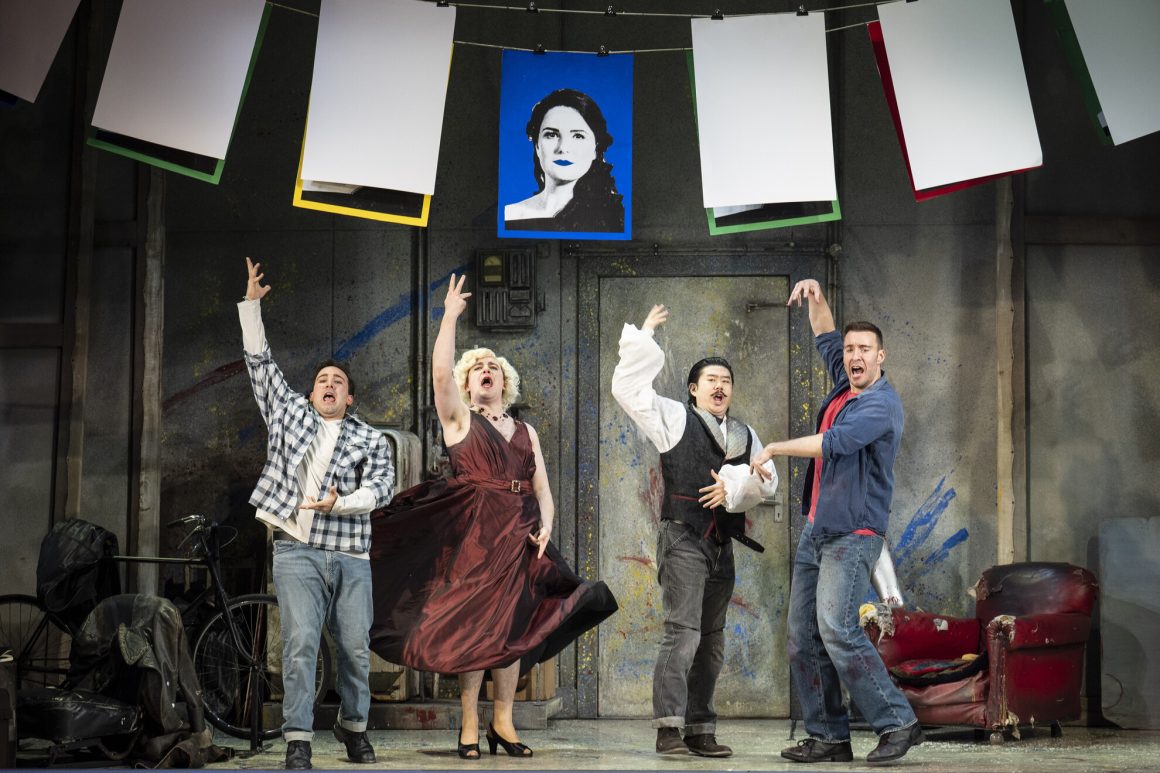
Yuriy Yurchuk as Marcello
They contrasted well with the adult customers out for a good time and especially with the thuggish sailors in uniform who posed with them, on the lookout for casual partners, a reminder that starving
seamstresses could always turn to selling sex if they wanted – or perhaps if they did not want.
The final act was properly restrained and emotionally draining, as usual for those in the audience who have seen it in previous productions (lots of them) and as a revelation for newcomers to opera who had not realised how much the operatic experience could affect them. Forget spoilers, because as in ancient Greek dramas, we knew what was going to happen. We are reminded that love is valuable because it exists in a world of human fragility, and it can not beat the inescapability of loss.
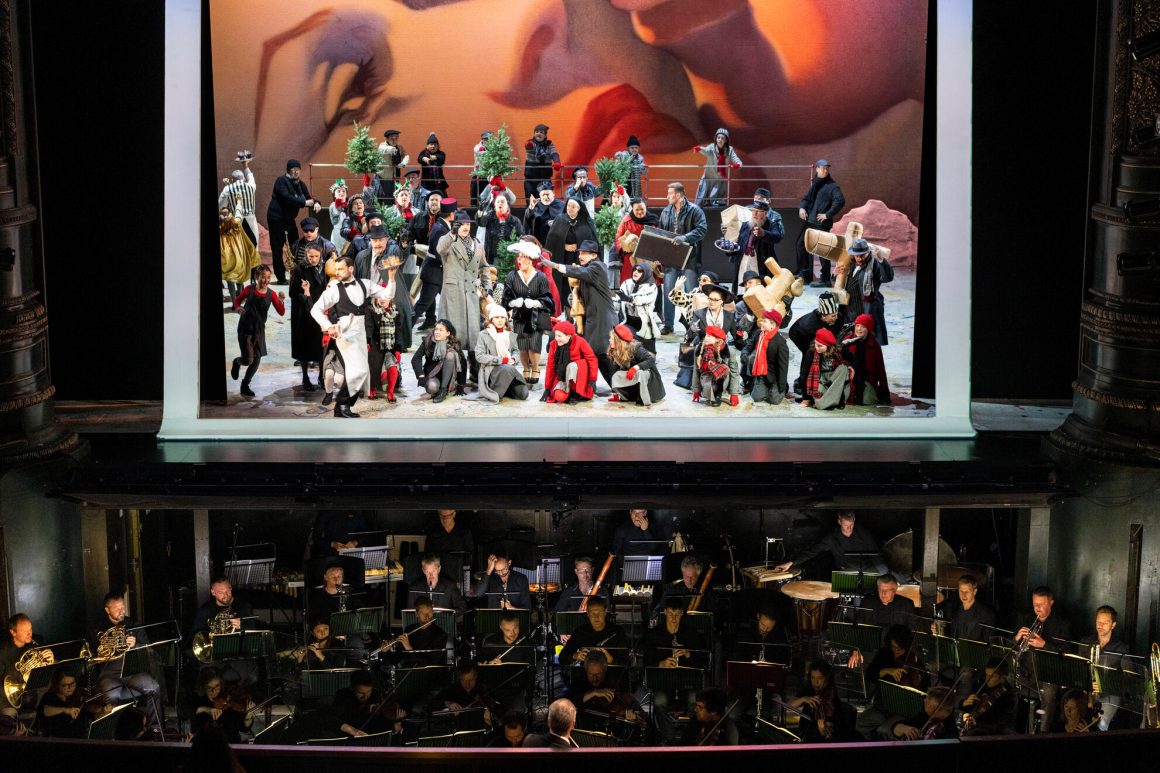
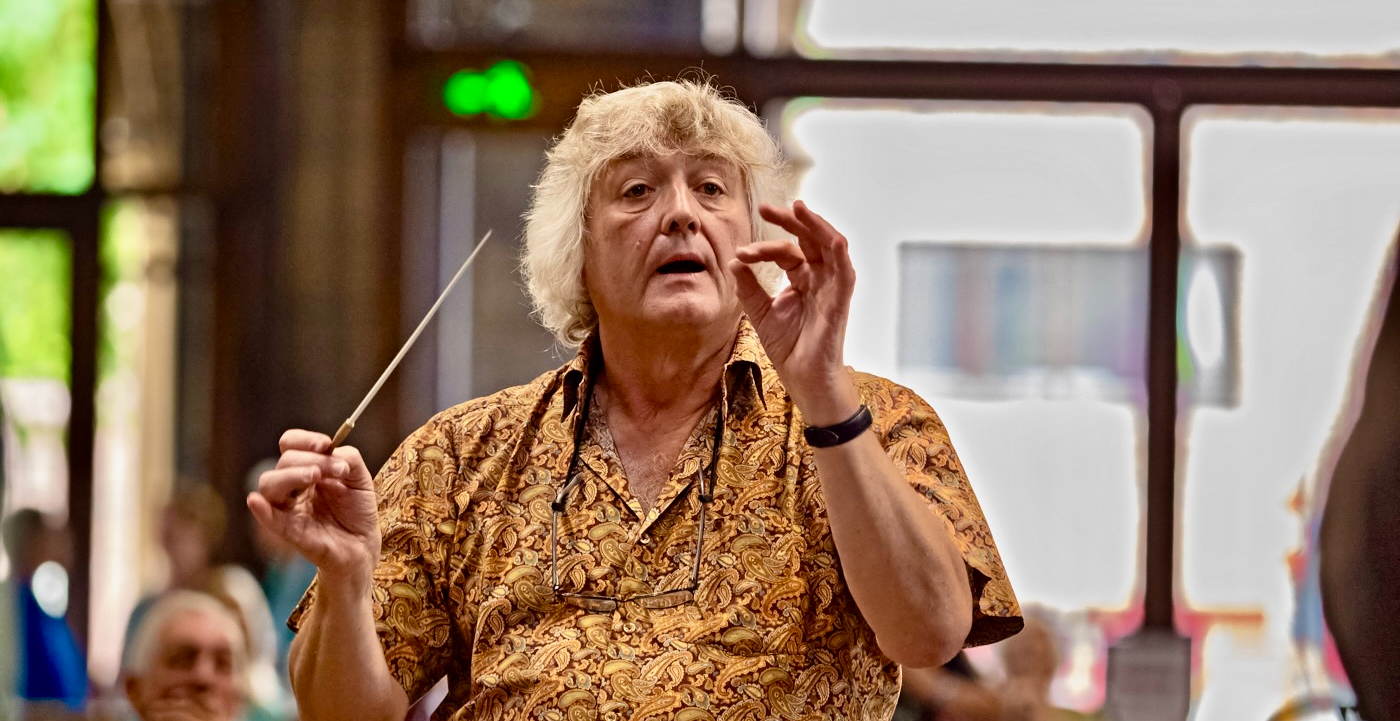
Garry Walker conducted the orchestra of Opera North with talent and sensitivity, making sure that the intimate qualities of Puccini’s melodies were brought out, and that the delicate motifs associated with Mimi were well-addressed as well as Rodolfo’s increasing desperation and inner turmoil.
Photography by Richard H Smith.
Main image – Opera North’s production of Puccini’s La bohème. Han Kim as Colline, Seán Boylan as Schaunard and Elin Pritchard as Musetta, with members of the Chorus of Opera North.
Conductor Garry Walker
Director Phyllida Lloyd
Revival Director James Hurley
Set & Costume Designer Anthony Ward
Lighting Designer Rick Fisher
Revival Lighting Designer Richard Moore
Choreographer Quinny Sacks
Revival Choreographer Maxine Braham
La Bohème is at Leeds Grand Theatre until 1 November. SOLD OUT.