
The celebrated musicologist, Hans Keller, first encountered the music of Benjamin Britten in the initial run of the composer’s first proper opera, Peter Grimes, at Sadler’s Wells in the summer of 1945.
A musician by upbringing and psychoanalyst by education, Keller was astounded – apart from thinking it was to be a performance of Mozart’s Così Fan Tutte that night – at the dramatic depiction of a man, “a living conflict”, unwinding before his very eyes and ears.
As grim and gritty as any Suffolk beach, Phyllida Lloyd‘s production is fully twenty years old now, but still retains its elemental emotion and raw, visceral power.
“I wanted to express my awareness of the perpetual struggle of men and women whose livelihood depends on the sea,” wrote the librettist, Montagu Slater, when adapting George Crabbe’s East Anglian poetic tale from 1810. And here the sea is everywhere, on each page of Britten’s score, in each scene of the stage action. Like the fickle gods of ancient times, it is an ever-present capricious background to daily life. Only the unwary and foolhardy ignore it. No plan can be put in place, no stock taken without reference to its current mood and what future misfortune it might bring.
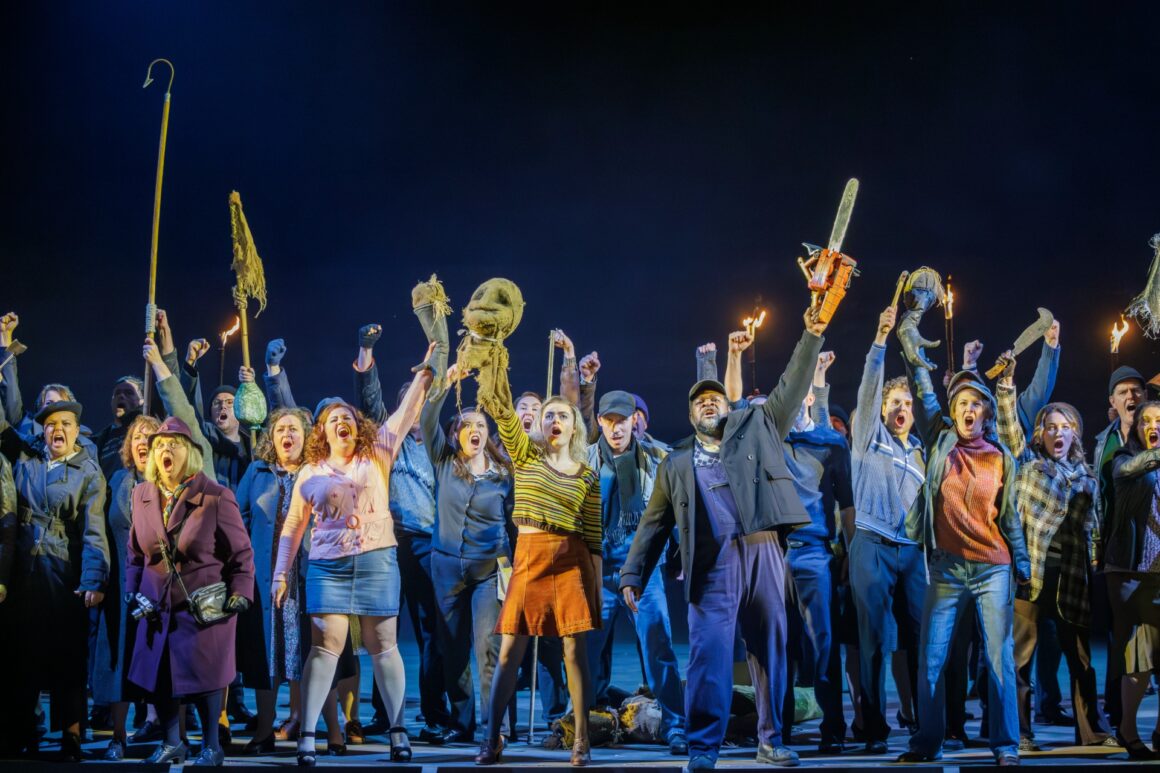
Opera North’s chorus sings with its customary gleaming and menacing splendour, depicting the outwardly-decent, judgementally-critical citizenry living these challenged and unpredictable lives. Together, they mend nets, revel at the local pub, sing shanties and Sunday psalms, evoke mob rule … Unnecessary burdensome complications cannot be tolerated. They must reject the uncomfortable, the unclassifiable, the deviant which makes their hard life just a little, and yet so much, harder.
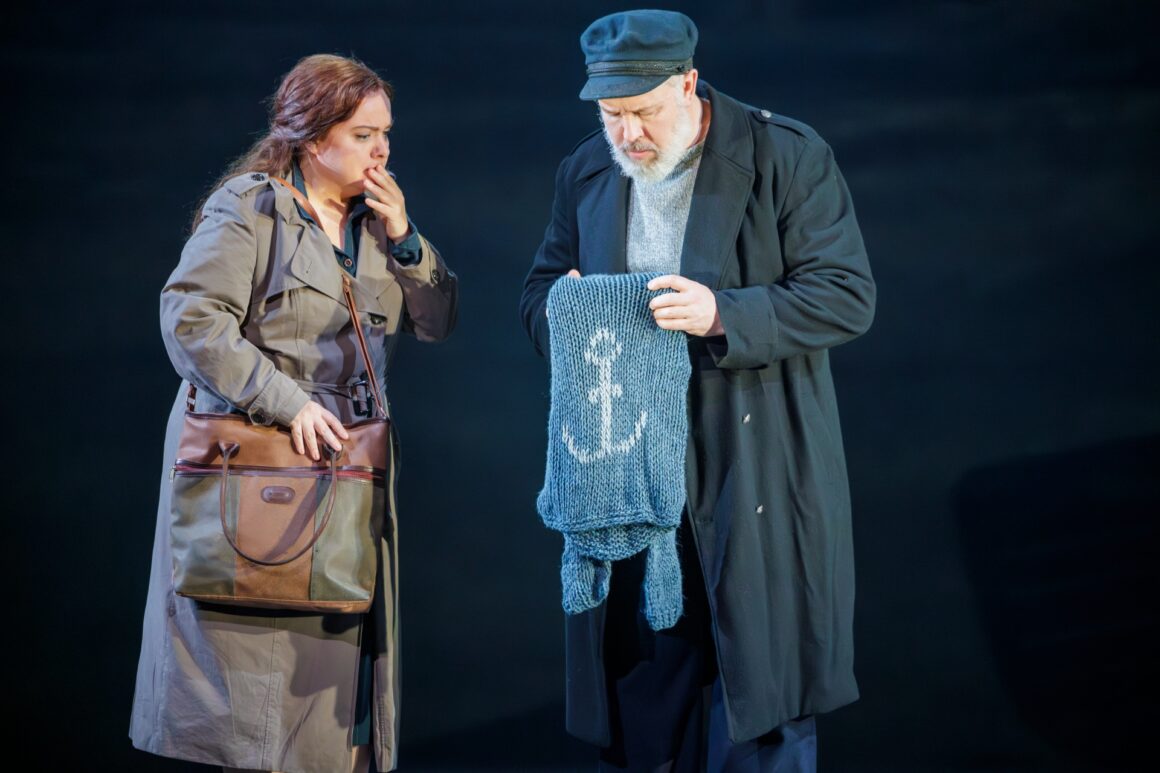
Amongst them are various vividly-drawn individual parts:
Simon Bailey‘s Captain Balstrode, a retired merchant skipper, delivers his knowing observations and advice in apt baritonal manner. Sagacious and experienced in the shortcomings of human nature, perhaps only he can recognise Grimes’ ambiguous nature and is able to foretell dispassionately the tale’s tragic resolution.
Johannes Moore portrays the village spiv-cum-apothecary, Ned Keene, with suitable jack-the-lad swagger. For a fee (of course), not only can he provide Grimes with boy apprentices from the workhouse, he plies moralising and gossip-prone Claire Pascoe‘s Mrs. Sedley with her regular opium fix. She epitomises the community’s hypocrisy, hidden behind an outwardly upstanding, righteous manner.
Most engaging of all is the Bob Boles of Stuart Jackson. This assertive, half-mad comic-Methodist is never far from his bible, his drink and his women.
Hilary Summers, playing the colloquially-known “Auntie”, runs the village local pub and shelter, The Boar, and, with two “nieces”, Nazan Fikret and Ava Dodd, manages its sideline whorehouse business. Vocally, the three combine with the heroine Ellen Orford in a touching, almost motherly Act II quartet, “Do we smile or do we weep or wait quietly till they sleep?”, a description of a woman’s role in this isolated society.
Though the two principal figures are Grimes and Ellen, the subject matter of the opera, as Keller perceived it on that first night, was what he considered to be “psychological terror” directed against an oddball they could not contain.
Crabbe’s original was an unfettered, callous bully:
” … none inquired how Peter used the rope,
Or what the bruise, that made the stripling stoop;
None could the ridges on his back behold,
None sought him shivering in the winter’s cold;
None put the question, “Peter, dost thou give
The boy his food? — What, man! the lad must live.
Consider, Peter, let the child have bread,
He’ll serve thee better if he’s stroked and fed.”
None reasoned thus — and some, on hearing cries,
Said calmly, “Grimes is at his exercise.”
Operatic directors of old used to portray this sadistic obsessive as Crabbe offered him and provided the gnarled, hard-hearted features to go with it. Nowadays, the tendency is to countenance a man aware of his own mental sickness, but, ultimately, unable to help himself. The apprentices do not die directly at his hands, but in circumstances beyond his control, a fatal slip from a cliff face or on board his fishing boat, cruelly blown off-course for days on end without adequate drinking water. Obviously capable of loving and injuring at the same time, to the townsfolk, Grimes nevertheless behaves as if he is guilty, even if he is not. Paradoxically, to him, they respect only money, but his own attempts at enrichment serve only to antagonise them further.
Philippa Boyle, who plays Orford, the schoolmistress, has a most impressive vocal range and colour. Her haunting, imploring middle-range is applied to urge Grimes to mend his ways; her fulsome, lucid and bright top-range desperately seeks his love and a settled life together. She makes a delicious homily out of the Act I, “Let Her Among You Without Fault Cast The First Stone”, the voice shimmers for the Act II, “Glitter Of Waves And Glitter Of Sunlight”, kindness itself with the boy apprentice and a haunted tone to the realisation that Grimes has indeed been “at his exercise”.
With this clear evidence of injury to the boy, John Findon‘s Grimes can no longer lay claim to any romanticised notion of a misjudged victim of society and so worthy of our sympathy.
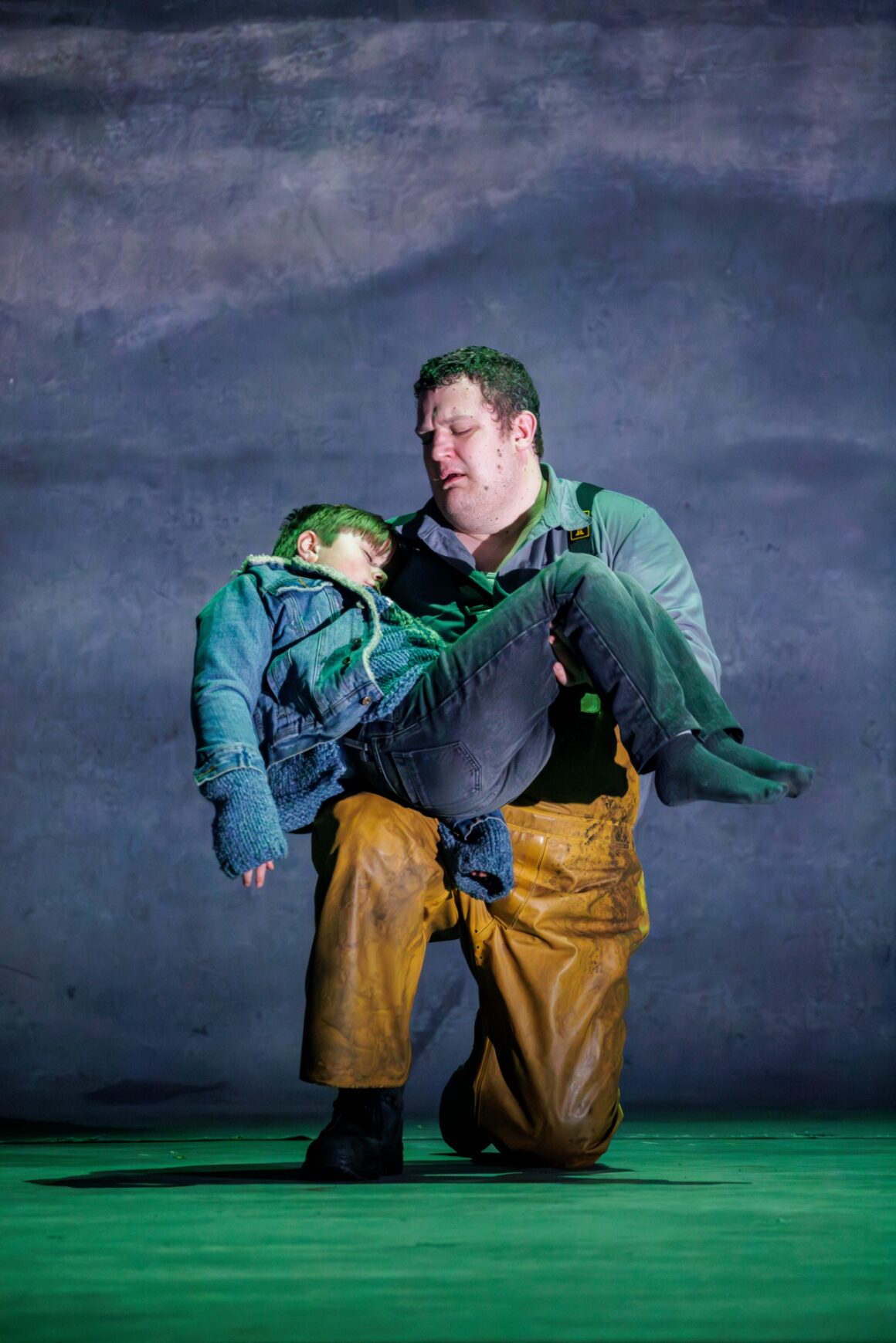
He sang with poignant gentility in the Act I, “Now The Great Bear And Pleiades” and, though now on the run, he still dreams of the big catch and the wealth to marry Ellen. Nevertheless, we join the crowd’s frenzied witch-hunt and witness Grimes’ descent into darkness, making for a gripping conclusion.
The wealth of vivid orchestral colours and textures offered by Britten’s masterly score is realised brilliantly by Opera North’s orchestra. Conductor Garry Walker shows us just what lavish musical invention is at play.
At this initial attempt at a large-scale stage work, Britten’s dramatic instincts, derived seemingly from everywhere and nowhere, did not fail him. There was no previous English tradition to guide him and Peter Grimes, as the start of all modern English opera, remains the epoch-making testament of an undoubted British musical genius.
19-year-old Hans Keller lived in Vienna at the time of the Nazi annexation of Austria and, as a Jew, suffered arrest and interrogation after the Kristallnacht pogrom in November 1938. Given the opportunity, he realised full well the twisted terror of which man was capable. Seven years later, in the theatre at Sadler’s Wells, he had not forgotten:
“Not every man has a conflict so exposed, or is driven to so desperate a solution. But there is a Grimes in us all.”
Touring Theatre Royal, Nottingham; Lowry, Salford Quays; Theatre Royal, Newcastle until 20 March
Sung in English, with English surtitles.
Main image: John Findon as Peter Grimes
Photography by James Glossop.
Conductor Garry Walker
Director Phyllida Lloyd
Revival Directors Karolina Sofulak/ Tim Claydon
Set & Costume Designer Anthony Ward
Original Lighting Designer Paule Constable
Revival Lighting Designer Ben Jacobs
Movement Director Tim Claydon


