To Kill A Mockingbird – A Masterclass in Excellence. Maria Forryan
Last night I saw To Kill a Mockingbird — Harper Lee’s classic reimagined in Aaron Sorkin’s new play, directed with brilliance by Bartlett Sher. Performed at our very own Leeds Playhouse, this has to be one of the most powerful and accomplished productions I’ve seen in the last decade.

To Kill a Mockingbird is set in 1930s Alabama and tells the story of Scout Finch, a young girl whose father, Atticus, is a lawyer defending Tom Robinson, a black man wrongly accused of raping a white woman. In this production, we see the story unfold not just through Scout’s eyes, but also through her brother Jem’s and those of their new friend, Dill. As the gripping drama unfolds, we see the racism and injustice that reside in their community, whilst they also learn about empathy and morality, especially through their mysterious neighbour, Boo Radley.
The script for this new adaptation is phenomenal — how a story filled with such tragedy can hold so much effortless, natural comedy is beyond me. The clever, slick set changes (done by the cast themselves) kept the pace fast and the drama building beautifully.

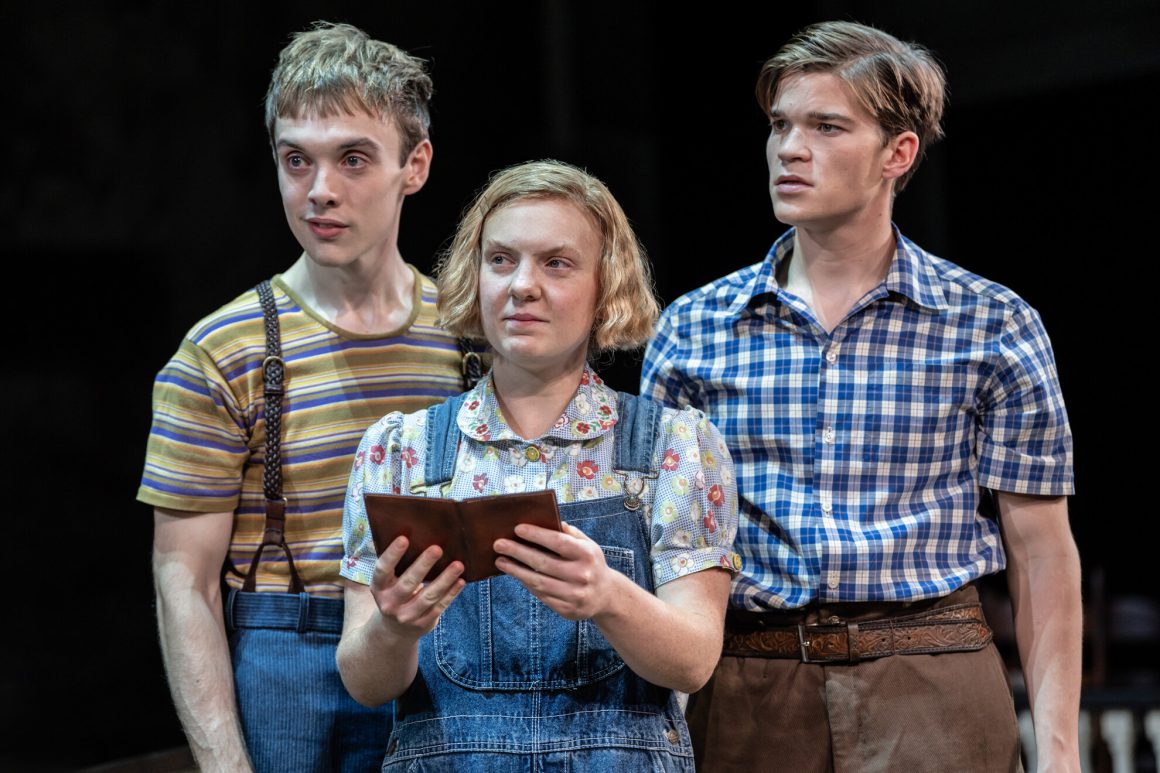
The roles of the children, played by Dylan Malyn, Anna Munden, and Gabriel Scott, were strikingly real and believable. Their narration was innocent and comedic, but in a way that didn’t diminish the drama of the story. Dill was especially comedic, his character charming to the point where you wanted to run on stage and give him a big hug.

Another highlight for me was Richard Coyle as Atticus Finch; his maturity and passion were worlds away from the Jeff I remember from BBC’s ‘Coupling’. He portrayed the difficult predicaments he faced with stunning conviction. However, every single cast member deserves a mention; the ensemble was a sheer masterclass in acting, including standout moments from Aaron Shosanya, Oscar Pearce and Evie Hargreaves.

The most poignant realisation is that this powerful story is as shockingly relevant today as it was 65 years ago. Many of the aspects of society that threatened to unravel nearly 100 years ago when the play was set are still major issues today. This is a long production at nearly three hours but don’t let that put you off – I was gripped for the entire time and even wished it had gone on longer. In addition, please notice the slightly earlier start time of 7.15pm for evening performances. This is a must see for anyone over the age of 12 as it’s a masterclass, not just in brilliant acting, but also in writing, directing and stage design.
Get your tickets now… they’re selling fast!
The new production of To Kill a Mockingbird at Leeds Playhouse is a thoughtful and striking reimagining of Harper Lee’s novel. Anne Guy
It places voice at the centre of the story, asking who gets to speak and who remains silent.
What stood out immediately was the quietness. There is almost no music, and even in the courtroom scenes, where you might expect overlapping arguments and noise, the stage allows only one voice at a time. A character will hold our attention for a while, then hand the story to someone else. This makes us listen more carefully, and each voice feels sharper and more distinct.

The narration is handled in the same way. Instead of Scout alone telling the story, as in the original text, she now shares it with Jem and Dill. They never speak over each other but take turns, passing the narrative between them. It feels both communal and personal, reminding us that one story is never enough to capture a whole community.
This structure also addresses a weakness in the novel itself. Black characters, though central to the events, speak minimally in the original text. In this production, their voices are clearer and uninterrupted, and the audience is given the space to hear them fully. But the production does not stop there. Everyone has their moment, from Mayella Ewell to Atticus’ son Jem to Dill, who is often dismissed as dumb. Each perspective is allowed to stand on its own, however uncomfortable or flawed.

A line that stayed with me was, “A person is smart, people are dumb.” It turns out this is from Men in Black, not Harper Lee, but it captures what the production achieves. It pulls individuals out of the crowd and refuses to let them disappear into stereotype. No one is treated as part of a faceless mob. Each character is seen clearly, with all their faults and contradictions.
The effect is unsettling as much as it is humane. We are asked to confront every character, whether sympathetic or not, and to sit with their words. The maid, Atticus, Mayella all demand our attention. By giving each of them space, the production shows how listening closely is both difficult and necessary.
Leeds Playhouse’s Quarry Theatre
Age guide 12+
Running time 2 hours 50 including interval
Access Performances
British Sign Language (BSL) interpreted: Wednesday 17 September 7.15pm; Thursday 25 September 7.15pm
Audio described (plus Touch Tour): Tuesday, 23 September 7.15pm; Friday 3 October 7.15pm; Saturday 4 October 1pm
Captioned: Thursday 25 September 12pm and 7.15pm; Saturday 27 September 7.15pm
Access productions at Leeds Playhouse are sponsored by Principal and Access Partner Irwin Mitchell
Box office 0113 213 7700. Book online leedsplayhouse.org.uk
Main image Aaron Shosanya and Richard Coyle.
Photography by Johan Persson.