The work of artists Felicity Aylieff and Laura Ellen Bacon.
Your house may be decorated with willow or ceramics. You probably have wicker baskets and clay bowls.
We have become used to thinking of these materials on a household scale but Yorkshire Sculpture Park
(YSP) is displaying the work of artists who have taken these everyday materials and upscaled them to
monumental size.

Entering the Yorkshire Sculpture Park from the Weston Gallery entrance you cannot miss Felicity Aylieff’s
towering obelisks. Flanking the gallery entrance, the blue and white ceramics tower over people and place.
Inside the gallery, Expressions in Blue consists of more monumental ceramic vessels.
As a frequent watcher of Pottery Throwdown, I found my conceptions of pot throwing completely undermined. Forget everything you thought you knew about using thumbs and palms to shape clay – here, elbows and multiple bodies have forced the clay into shape.

Aylieff’s journey towards this unprecedented scale began with a visit to the city of Jingdezhen in China in 2005, famous for its high-quality porcelain. This is a truly collaborative exhibition. A documentary follows the creation of one of the pots from selection of the clay by Aylieff, through a team of skilled craftspeople constructing the vessel, then Aylieff’s use of giant horse hair brushes and step ladders when decorating. The potter’s wheel would fill a normal artist’s studio, but room is also needed for a team of five potters and lifting machinery. The largest creations are made in sections and then carefully stacked on top of one another.
Blue and white has been used to echo traditional Chinese ceramics, but the decoration is free flowing and organic, a style Aylieff describes as New Ming. Horse hair, bunches of bale twine and other natural products are used to decorate. Having seen the physicality of production and decoration on the video presentation,the vessels become even more imposing.
Over in the Chapel, Laura Ellen Bacon has produced similar economies of scale with willow. Into Being, created for YSP, sees woven willow sculpture built in situ interacting with the 18th-century Chapel architecture. The light, which flows through different chapel windows as the day progresses, highlights the intricacy of weave or throws interior sections into shadow.

Bacon has said of the process: “Making it on site was a dream. I was able to work with the rising and falling light in the space, both of which inform the flow of the inner folds of weave. Also, I could witness the acoustics of the space change when I’m deep in the woven willow folds.”
The title refers to the intense process of creating the exhibition. It took Bacon eight weeks to construct, a work of solitary commitment in contrast to Aylieff’s collaborative process. As part of the supporting structure, she used fallen beech branches from YSP. She crafted around 80 bundles of Somerset willow, known as Dicky Meadows and famed for slender straight stems, to create her forms. At the end of the exhibition, the willow will be used in animal habitats around the park.
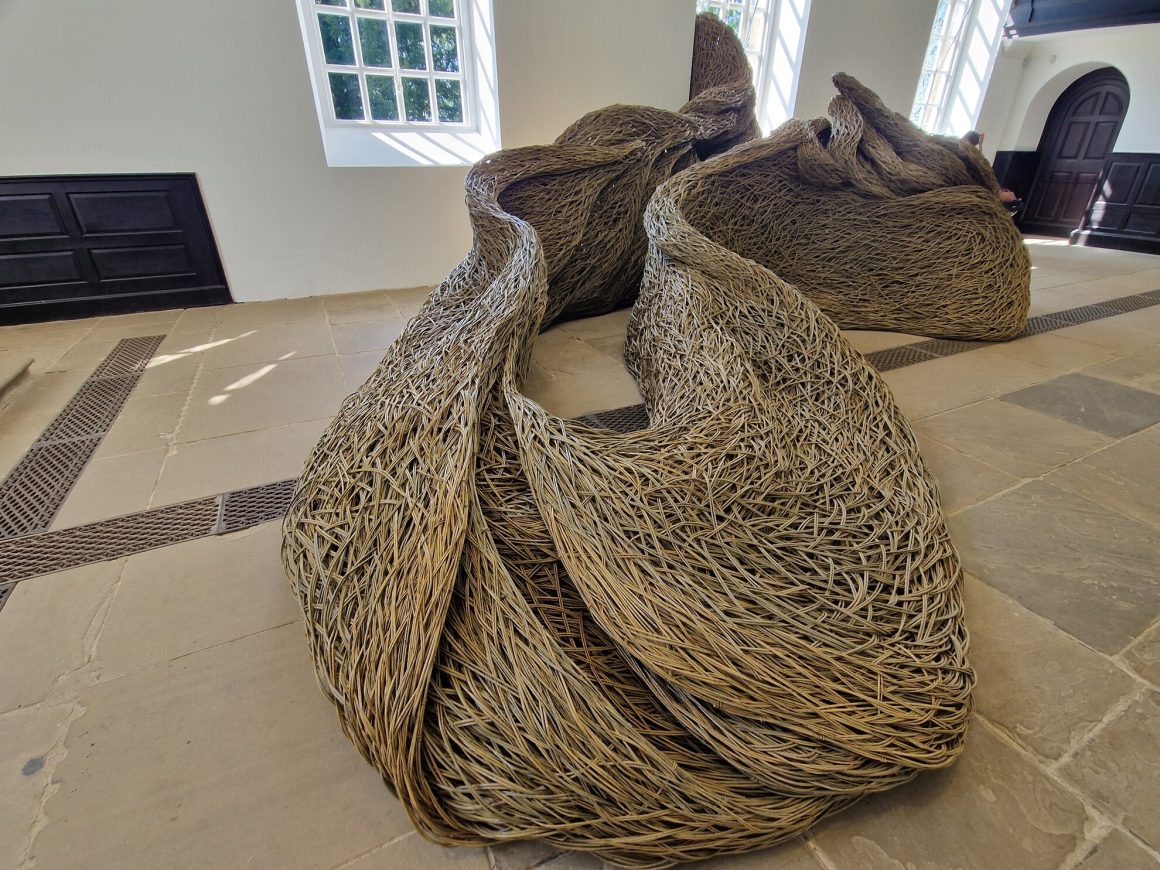
The sculptures lead you around the chapel; flowing, folding and curling, the firm willow softened by curving forms. The largest invites you to wander inside, cocooned from the outside world. This is a sensory experience; the smell of willow, the effect of light and a sense that your body is moving in reaction to the sculpture. The scale is grand but everything is constructed by hand.
Both exhibitions are a testament to ancient craftsmanship adapted to a modern age. I left with an appreciation of the basic materials of clay and willow, their historical importance and their ability in the hands of skilled artists to provoke awe, sensory and emotional responses.
Both exhibitions continue until September.
Further details from Yorkshire Sculpture Park https://ysp.org.uk
Photography by Debbie Rolls.