There is still time to see the Turner Prize in Bradford.
Bradford City of Culture 2025 is over. Well, not quite. Cartwright Hall is still displaying the prestigious Turner Prize exhibition until February 22nd. I have visited twice: once to a curator’s tour and once on New Year’s Eve. If you have not been, then I highly recommend a trip to Bradford while you still have the chance.
There are five artistic presences here – the four short listed artists and Cartwright Hall. I have seen earlier Turner exhibitions at the Tate and Baltic. In these galleries white walls were a blank canvas, working well for display, but not adding dialogue. The history, location and physical presence of Cartwright Hall add another dimension to this exhibition.
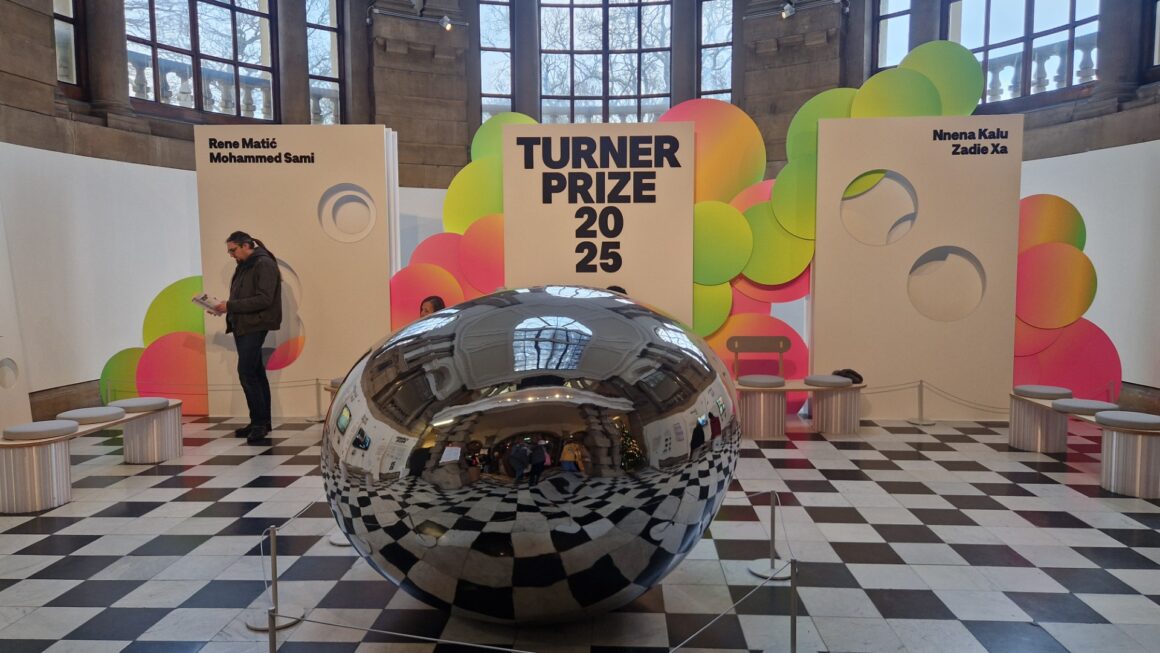
The first art you see is Anish Kapoor’s ‘Turning the world inside out’, pictured above. The stunning reflective globe was commissioned in 1997, not long after Kapoor had won the 1991 Turner Prize. This art sits in the centre of the atrium with the exhibition’s banner.
Around the edges are video points with recordings related to each of the four short listed artists. Make sure you leave yourself time to watch these, either before or after viewing the galleries, because they add depth to the experience.
I found Rene Matić’s video particularly revealing. Once I had learnt about their mixed-race beginnings in suburban Peterborough, the photography became more vivid. The contrast between the diverse alternative scene adopted in London and struggles growing up was more obvious. Even before I had seen the video, I was engaged by the collection of black dolls, many broken or damaged, all adopted and cared for by Matić. I often find dolls in exhibitions unsettling, but these were wrapped in care and emblematic of Matić’s call for justice and love of family.
I suggest following the order of the curator’s tour, so next make your way up the grand staircase. Another atrium area has a collection of pieces from Cartwright Hall’s permanent collection. You will also find two new artworks, Savage Ground I and Savage Ground II, by Emilie Taylor, a highly illustrated pair of ceramic pots with images of women working. Taylor worked with people at the Refugee and Women’s Allotments, part of Scotchman Road Allotments in Manningham, to develop her designs.
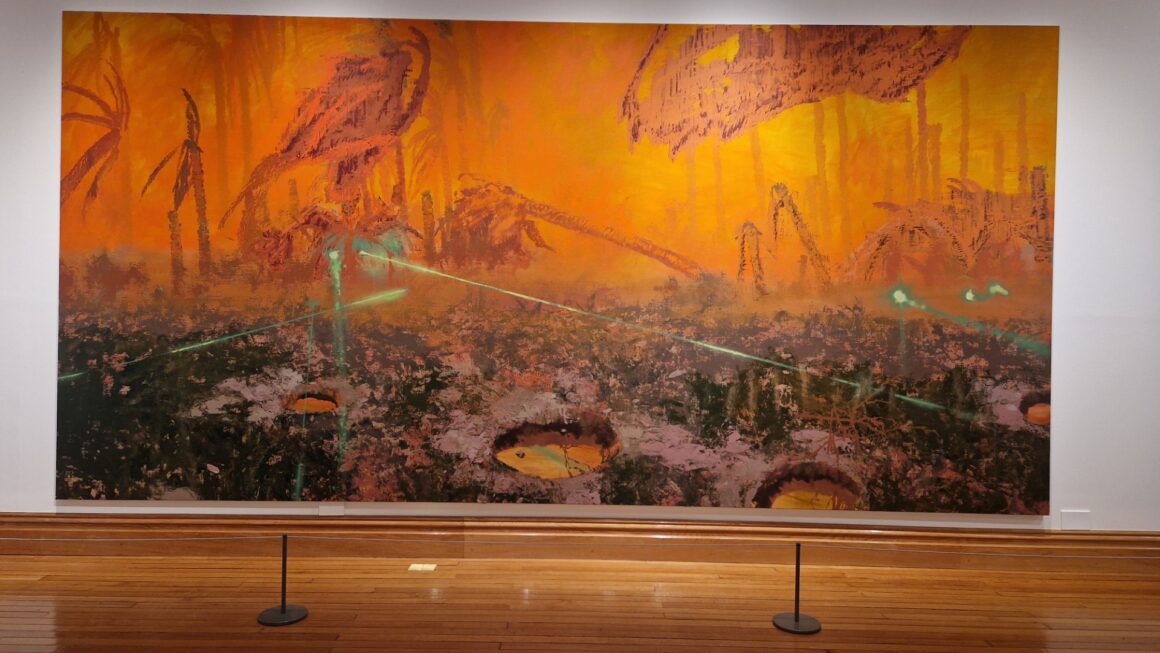
Mohammed Sami (work pictured above) brings his experiences of war to art. The canvases are devoid of people but can still carry threat. The work on display was developed for his solo exhibition After the Storm at Blenheim Palace.
Sami uses metaphor and ambiguity to create paintings about memory and conflict. These scenes might appear calm, but there were always questions about what had, or would, happen. Delivered with a vibrant palette, the large canvases draw you into questioning and developing narrative.
It was in this gallery on New Year’s Eve that I really noticed how different this was from my previous Turner experiences. There was the rich wood of the gallery floor but there was also a lot of conversation. The bank holiday had brought families of all ages, sizes and ethnicities into the gallery. And they were talking about art: pointing out details, claiming favourites and comparing ideas.
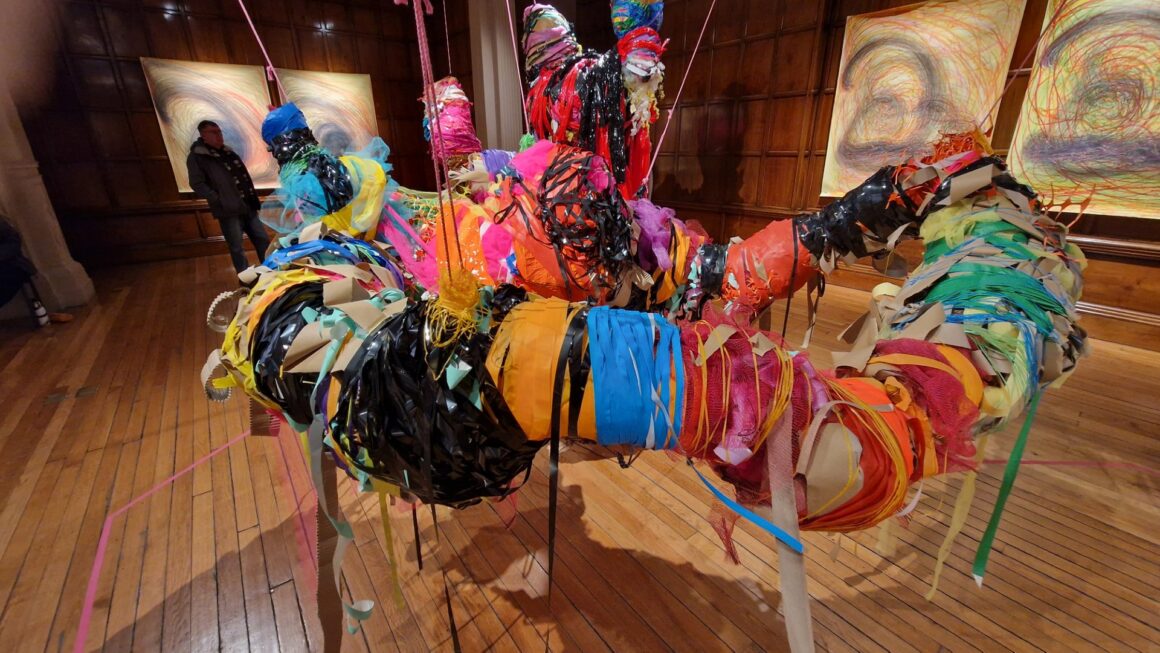
The conversations were just as frequent in the next gallery. Turner Prize winner Nnena Kalu’s work looked perfectly at home in the panelled room – her three-dimensional sculptures reaching through and across the space, her large drawings blending with the panelled walls. Largely created in situ, you can see her creating them in the video downstairs. They have been tailored by Kalu’s passion and Bradford’s space. Her art is led by her energy and body movement, whether she is wrapping sculpture or drawing. As a largely non-verbal autistic artist, her art communicates more than words.
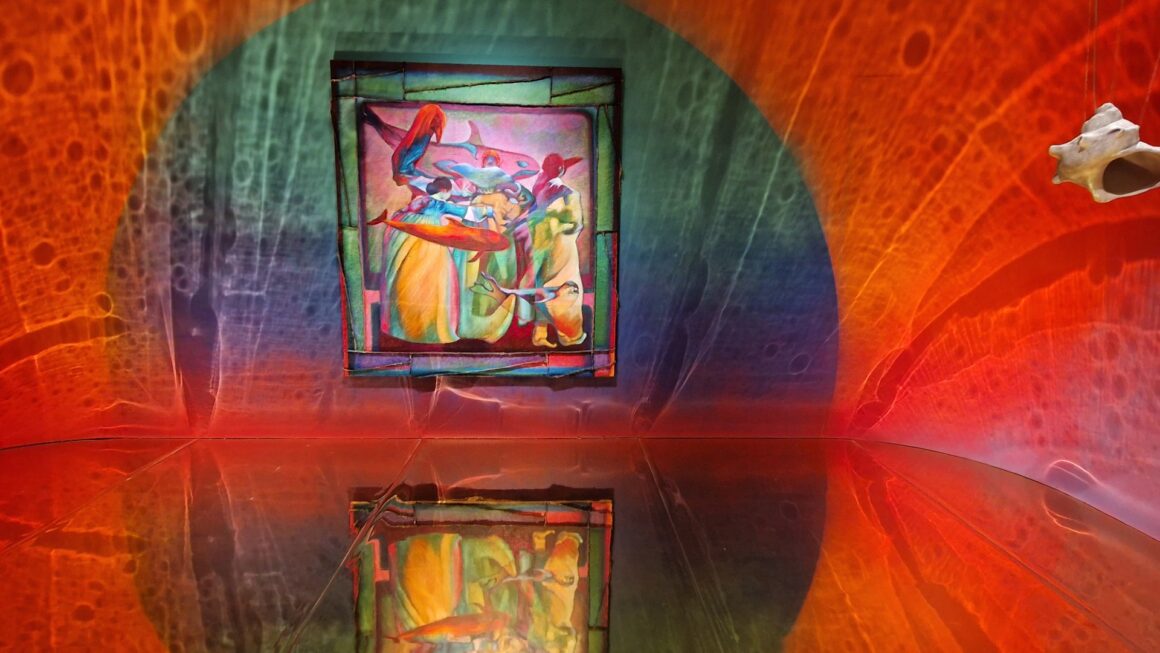
The final gallery, on the ground floor, astounds visitors by being even more immersive. Zadie Xa describes herself as an installation artist. Here, she has turned the whole gallery into an artwork. The floor has become a golden reflective surface which reflects artwork on the walls, hanging from the ceiling or positioned on the floor. You will need to wear shoe coverings or remove your shoes before entering. I would recommend shoe removal, so consider which socks to wear. I think I managed to hide a hole on my first visit.
Xa draws upon folklore traditions to create alternative worlds. We are enfolded into a world of myths and beautiful sea creatures, the imagery influenced by her Korean and Canadian roots. The gallery floor and walls have been completely transformed with paint and metal. The recessed ceiling can still be seen but is scattered with shadows, some of which move as strings gently sway below. Suspended natural shapes carry soundscapes, adding to the sensory experience.
The exhibition is free, but high visitor numbers mean you do have to book a spot. On both days I visited, there were people who had travelled from the local area and further afield. One family were asking for advice on whether they could fit in a trip to the National Science and Media Museum while in the area. If the weather is good, it’s always worth taking a stroll around Lister Park. There is an attractive children’s playground and lots of historic features. The Refreshment Room Café has a good selection of affordable treats, great samosas and cakes, or it is only a short walk to one of my favourite Bradford eateries, Eden’s Tearoom & Patisserie.
One of the questions I heard people discussing was would JMW Turner have approved? Innovative, imaginative and fond of landscape, I think he would have found much to admire here. Matić’s gritty London streets, Sami’s thoughtful landscapes, Kalu’s inner space made solid, and Xa’s dreamworlds: all bring a new take to his tradition.
The exhibition runs until February 22nd
Cartwright Hall Art Gallery, Lister Park, Bradford, BD9 4NS
The eCar parking in park, numerous buses from Bradford City Centre or 20
minutes’ walk from Frizinghall Railway Station.
Book tickets here.
Main image: The work of Zadie Xa.
Photography by Debbie Rolls.