The exhibition’s title comes from Them & [Uz], a poem by Leeds-born Tony Harrison, a creative who never forgot his working-class origins.
Sadly, Harrison passed away in September, but he was pleased that the University of Leeds was using his words to highlight working-class artists.
All 36 artists featured are from, or have significant links, to Yorkshire.
A few of the artists, such as Henry Moore, are household names, whilst others were overlooked in their lifetime. Many are contemporary and emerging artists, still producing art today.
This is an exhibition with depth and breadth in terms of timeframe, medium and style. The work spans from 1930s work by Francis Butterfield and Henry Moore to Simeon Barclay’s This is a Safe Space (2025), developed specifically for the exhibition.
Curator Laura Claveria, herself from a working-class background, has done a magnificent job of presenting a diverse body of work, digging into the university archives, and attracting work from other sources.
For young working-class people today, there are enormous barriers to becoming, an artist. According to the Sutton Trust (2024), there are around four times as many younger adults from middle-class than working-class backgrounds working in the creative industries. The concentration of the art scene in London can also be prohibitive. Although judging from this exhibition, and Lives Less Ordinary: Working-Class Britain Re-Seen, an exhibition held in London earlier this year, the North seems more effective in attracting the working-class to the world of art. Many, such as Ajamu X whose early self portrait features here, are then drawn to the capital to develop their work. Hopefully, this exhibition will offer a beacon to
potential young working-class artists, highlIghting the value of their perspective and the potential of Yorkshire as a creative working-class hub.
Some of the artists engage directly with working-class experience: work, culture, or everyday life. Phillip Naviasky documented women working in the wool mills in the 1940s, while Grace Clifford’s metalwork relates to a more recent experience of working in a factory.
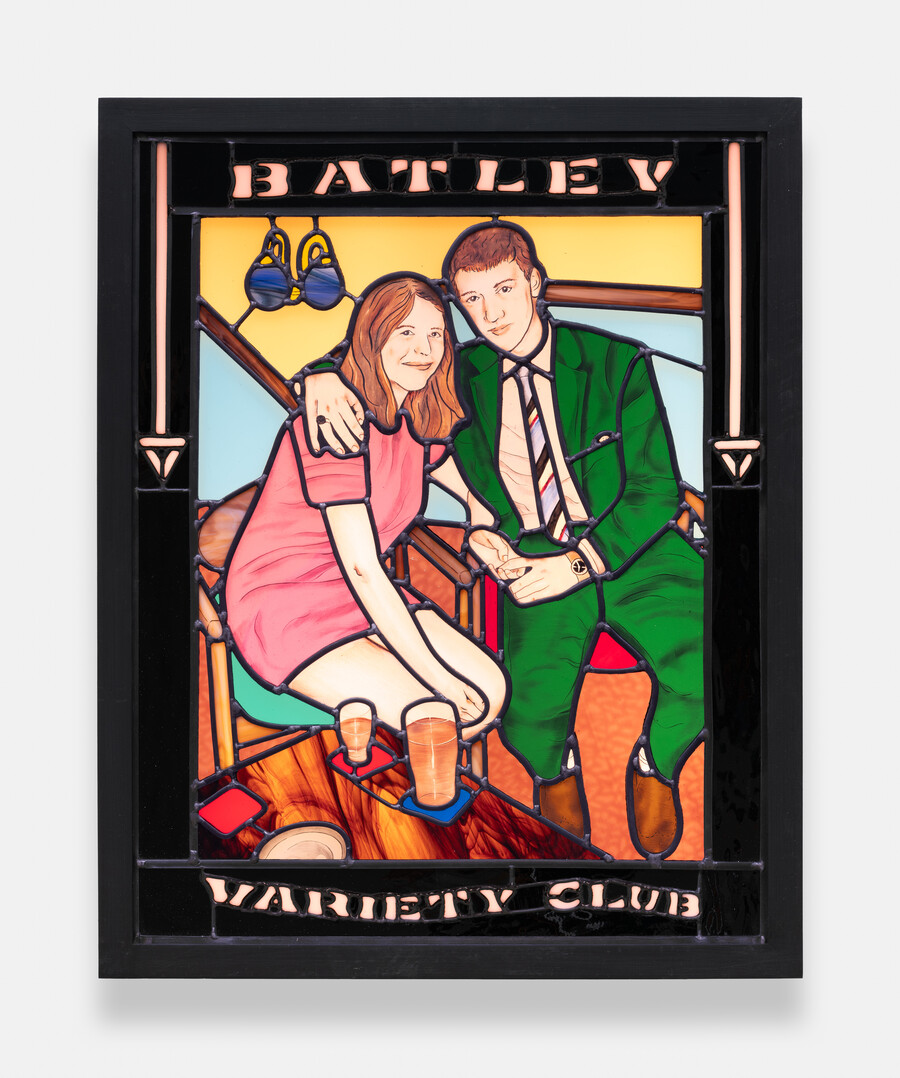
2023, glass, paint, metal, wood, LED ©The Artist. Courtesy of Jim Brook and Guts Gallery. Photo: Eva Herzog Studio.
Living and working in Dewsbury, West Yorkshire, Jim Brook explores his experience, masculinity, home, folk culture and class through the ready-made, sculpture, photography and textiles.
This work in stained glass is based on a photograph of Brook’s grandparents on their first date at Batley Variety Club. Some of the biggest names in showbusiness performed for working people in ‘the Las Vegas of the North’ through the 1960s and 70s.
Jim Brook in Two Lovers (2023) has looked back to the hey day of the Batley Variety Club, using stained glass to immortalise his grandparents, whilst Conor Rogers draws upon betting slips to explore working-class identity.
Beth Smith’s Comfort Food (1990) and Joseph Pighills’ Still Life (undated) take us into homes to view tables laden with food and crockery.
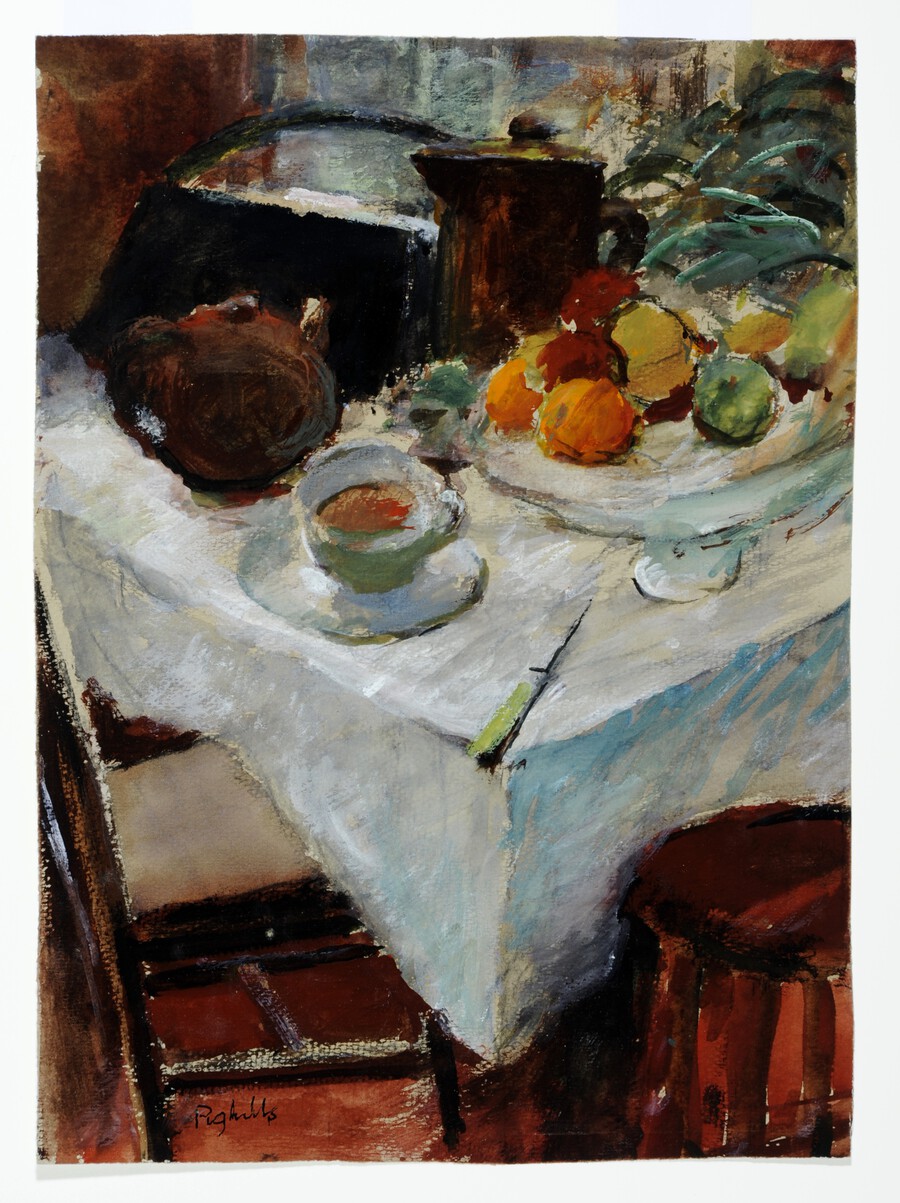
Undated, gouache on paper © Estate of the Artist. Cultural Collections and Galleries, University of Leeds Libraries, Art Collection.
Joseph Pighills (1902-1984) was born in Oxenhope, West Yorkshire and lived there most of his life. He left school at fourteen and apprenticed as a pattern maker. Pighills attended evening classes at Keighley College and joined Bradford Art Club, but only began painting seriously after taking early retirement in the mid-1960s.
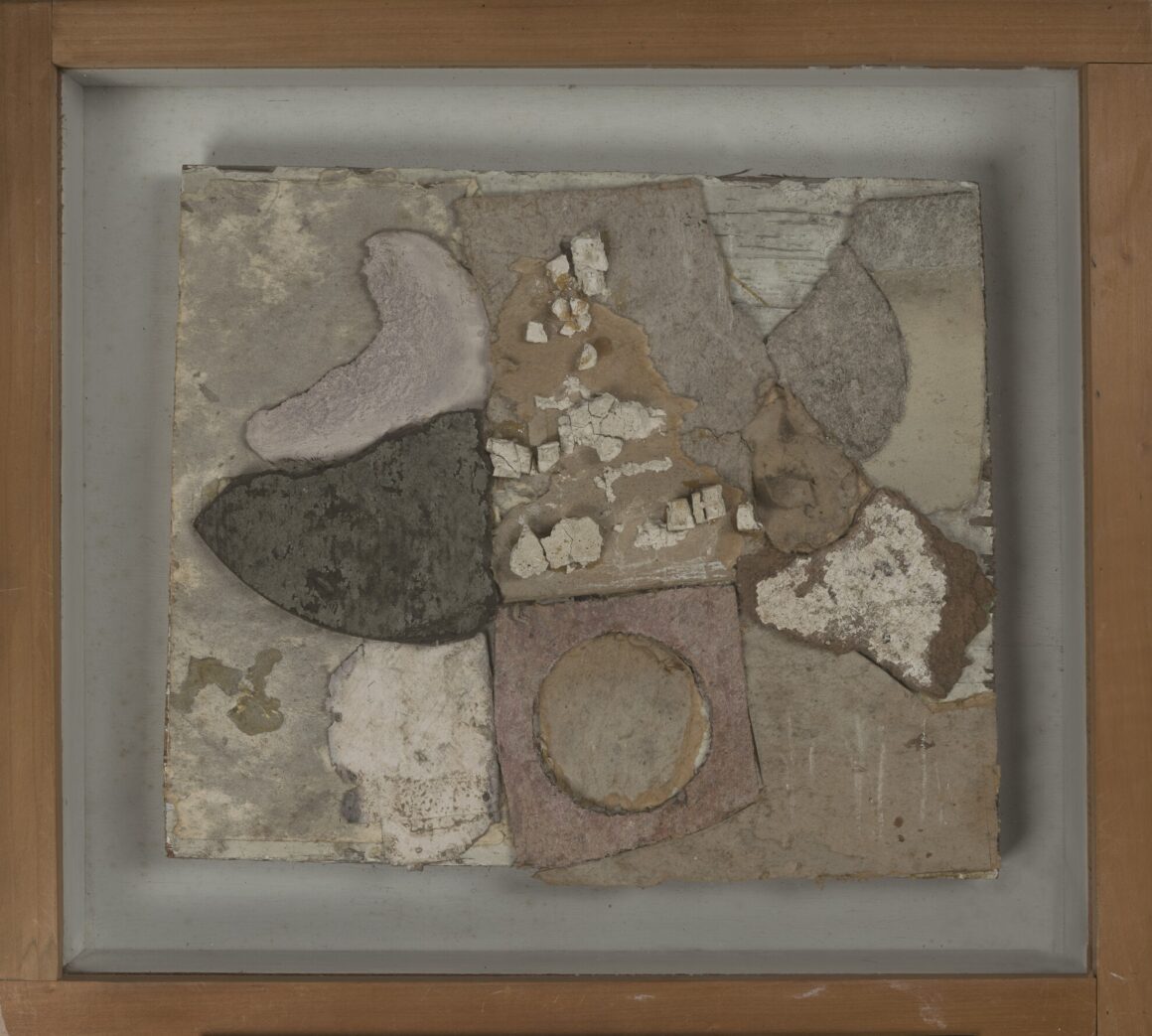
c.1970, mixed media. ©Estate of the Artist. Cultural Collections and Galleries, University of Leeds Libraries, Art Collection.
Like an alchemist, Harry Thubron (1915-1985) took the discarded and worthless and gave it new value. His junk aesthetic has been likened to Kurt Schwitters, Antoni Tàpies and Robert Rauschenberg. Composition, though, seems to refer as much to the British modernist Ben Nicholson.
Others have explored more abstract or general themes, but always from a working-class stance. Content ranges from the abstract work of Wendy Abbot and Harry Thubron through semi-abstract images such as Packer’s Farm Gate (1983) by Norman Stevens, which although a depiction of a real place is more concerned with the intersection of lines presented in bold colour.

1964, oil on board. *Orphan work. Cultural Collections and Galleries, University of Leeds Libraries, Art Collection.
Mary Lord (1931-2002) was born in Batley, Yorkshire. She studied at Leeds College of Art and taught at Swarthmore Adult Education Centre, Leeds College of Art and Leeds College of Technology. During the 1960s, she made several paintings of sunsets. She described her landscapes as being ‘inspired by my deep feelings for the landscape of the North of England, especially West Yorkshire and the Yorkshire Dales, which I have known all my life.’
Products by Terry Atkinson (1977), details the machinery of the First World War including details of manufacture, drawing attention to the capitalist industrial system behind war. Some of the artists explicitly reference their class origins, but this is not an exhibition about being working class, it is about showing that artists can come from a working-class background.
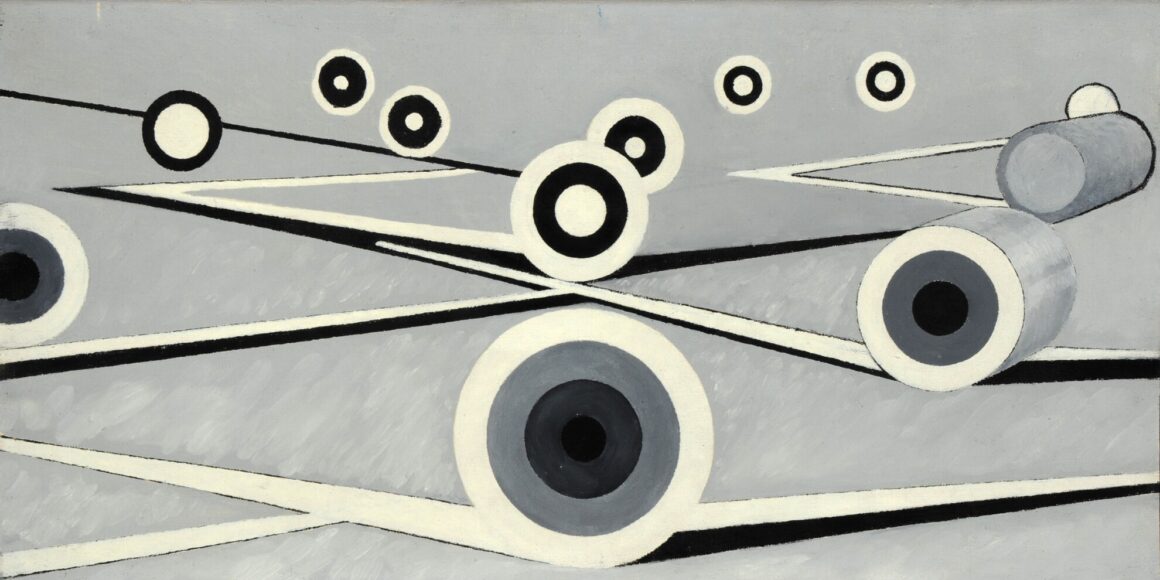
1968, oil on canvas. *Orphan work. Cultural Collections and Galleries, University of Leeds Libraries, Art Collection.
Wendy Abbott was born in Armley in 1943 and, in the artist’s words, she was brought up in a ‘dark, dingy house’ on a ‘dark, dingy street’. Often ill as a child, she spent a lot of time drawing in bed. Luckily, her father worked as a printer and could bring home offcuts of paper for her to use. Abbott completed an MA in Fine Art, studying under the pop artist Richard Hamilton. Her first solo show followed in 1967, but her career stalled as family responsibilities mounted. Abbott returned to art in her retirement.
In aerodynamics, ‘heavy air’ relates to propulsion, friction and drag. Abbott’s other works from the period address the space race, which reached its peak the year this painting was made.
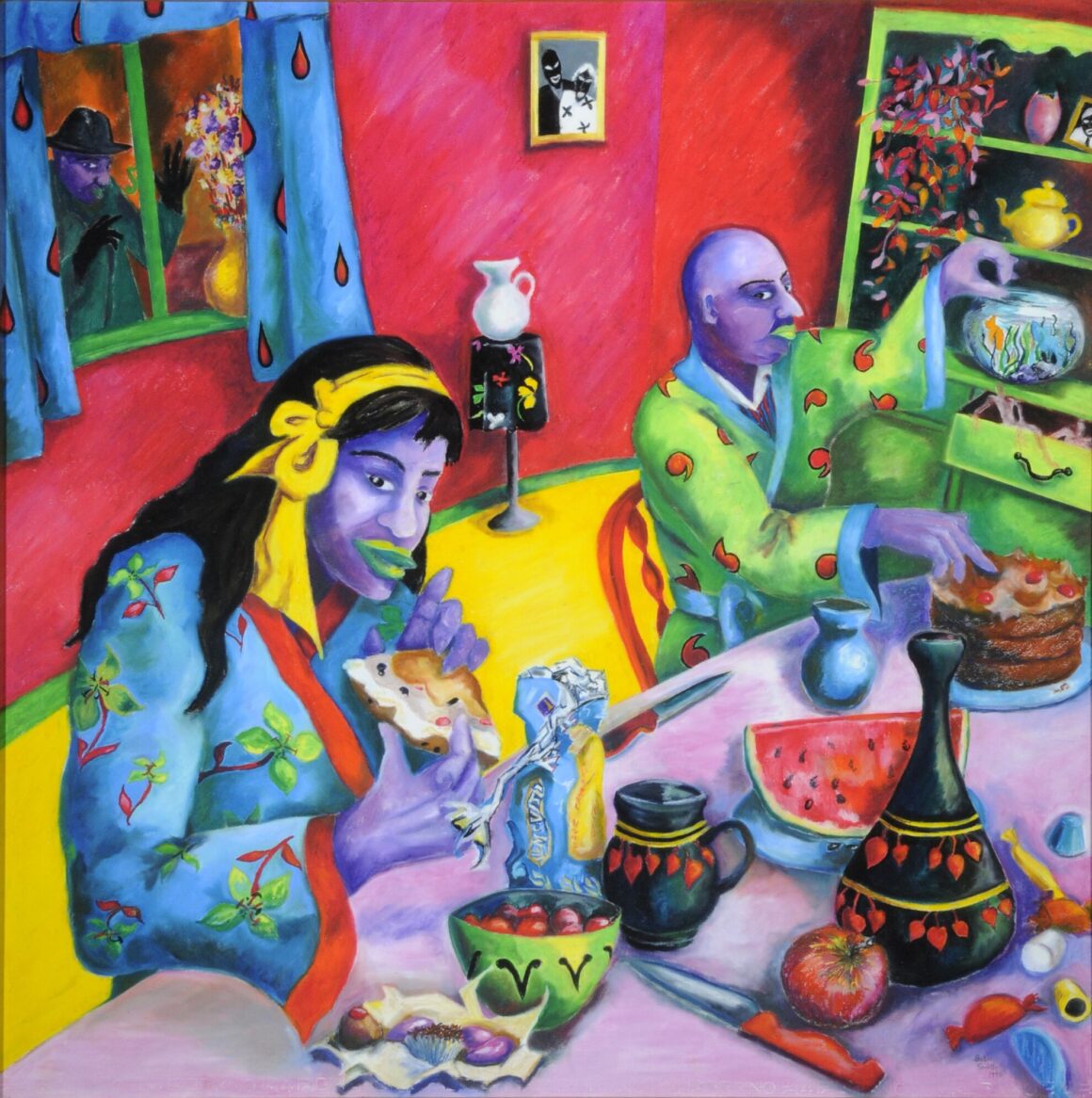
1990, Pastel on paper © Beth Smith. Cultural Collections and Galleries, University of Leeds Libraries, Art Collection.
The work of Beth Smith (b.1961) is often humorous and serious at the same time. In Comfort Food, bright colours and playful characters are tempered by an undercurrent of uncertainty and menace – the large knives on the table, the gloved figure at the window.
Smith: ‘The Cold War was ending, the Soviet Union was dissolving, dreadful wars were underway in the Balkans, racial brutality by US Police caused riots… In the UK, John Major led the Tories to victory again. Punk had been and gone, Thatcher’s legacy of individualism continued… What else was there to do but eat and keep cosy in the safety of home? However, relationships are not simple and tensions bubble under. Trouble could be brewing and God can see it all’.
Comfort Food is a popular painting, often on display around campus, but this is the first time it has been shown in the gallery.
Many of the artists had to overcome challenges to achieve their artistic goals. Some engaged with art intermittently or for a limited time. Mary Lord, Wendy Abbot, and Beth Smith all put their art careers on hold for long stretches whilst Francis Butterfield gave up art altogether due to the difficulty of earning a living. Working-class artists rarely have savings or family support to help them through. Some were aided by financial support from the University of Leeds. Both Dennis Creffield and Terry Frost won Gregory Fellowships that enabled them to concentrate on their art.
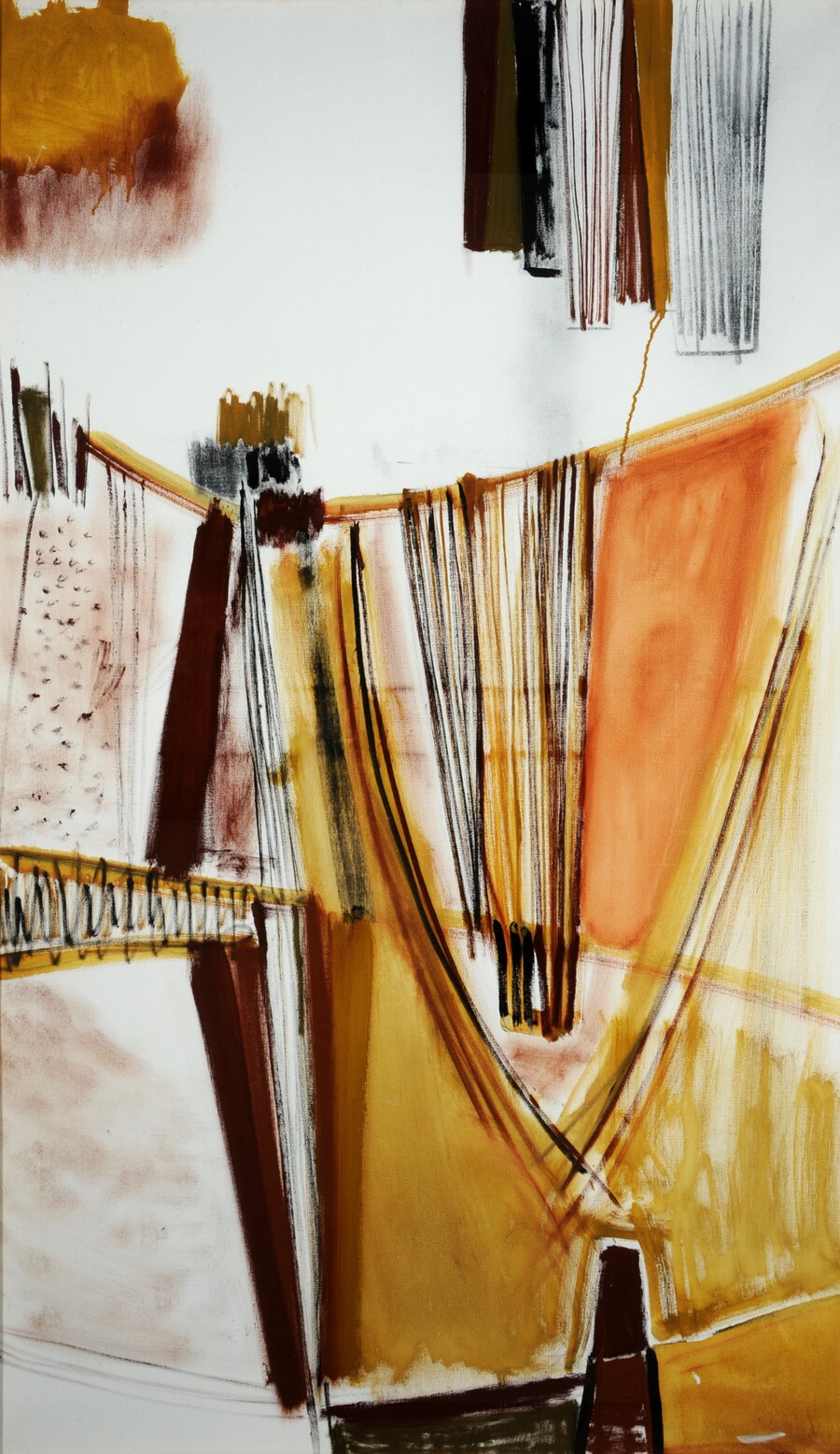
1957, oil on canvas. ©Courtesy of the Estate of Terry Frost. Cultural Collections and Galleries, University of Leeds Libraries, Art Collection.
Terry Frost painted Mars Red, Yellow and Brown in the autumn of 1957, three years after moving to Leeds to take up the role of Gregory Fellow in painting at the University. He embraced tall canvases and plunging forms over the course of his time here. This new vertical emphasis was derived in part from the patterns of stone walls running up the hillsides of the Yorkshire Dales, and in part from his experience of sledging downhill in Roundhay Park. Exposure to the Yorkshire landscape also changed Frost’s palette.
Frost was grateful for the Gregory Fellowship. It provided him with a regular income and an opportunity to paint full-time.
Class might be at the heart of the exhibition but there is a great deal of intersectionality. Maud Sulter’s Plantation (1995) explored the historical presence of black womenfolk in Europe, linking to the Brontes. Several black artists feature; there are also queer, disabled and feminist perspectives. I was a little disappointed that there was no one obviously of Asian descent; perhaps the University collection needs to address this, given the considerable Asian working-class communities in West Yorkshire.

2025, jesmonite, card, wire, acrylic paint and sealer © The Artist. Photo: Joshua Hart
Jill McKnight (b. 1990, Sunderland, UK) is an artist working across sculpture, works on paper and moving image. Central to her practice is exploring working-class, feminist and artistic lineages to tell stories that would otherwise be lost or overlooked. From starting points of archival research, interviews, family and community knowledge, recent work has sought to platform working-class experience.
My personal favourites are David Blackburn’s Untitled (1979), and George Storm Fletcher’s Recurring Rat Dreams II (2025). The first may be untitled by reminds me strongly of his native Huddersfield. The blurred pastel image of a hill surrounded town is somehow more visceral than any photo could ever be. Fletcher’s work repurposes domestic fuse boxes to form light boxes to reframe his nightmares. He has drawn upon the wiring skills taught to him by his dad, an influence he would not have received in a more affluent home where parents did not ‘fix’ and ‘make good.’
Laura Claveria and researcher Simon Marginson have reviewed all the artists in the University of Leeds Art Collection through the lens of class. They believe that this is the first time that such a study has been undertaken of any art collection in the UK. Their research has uncovered human stories, brought to light forgotten artists and works and encouraged new acquisitions to fill gaps. Kedisha Coakley and Simeon Barclay were both commissioned to produce new art.
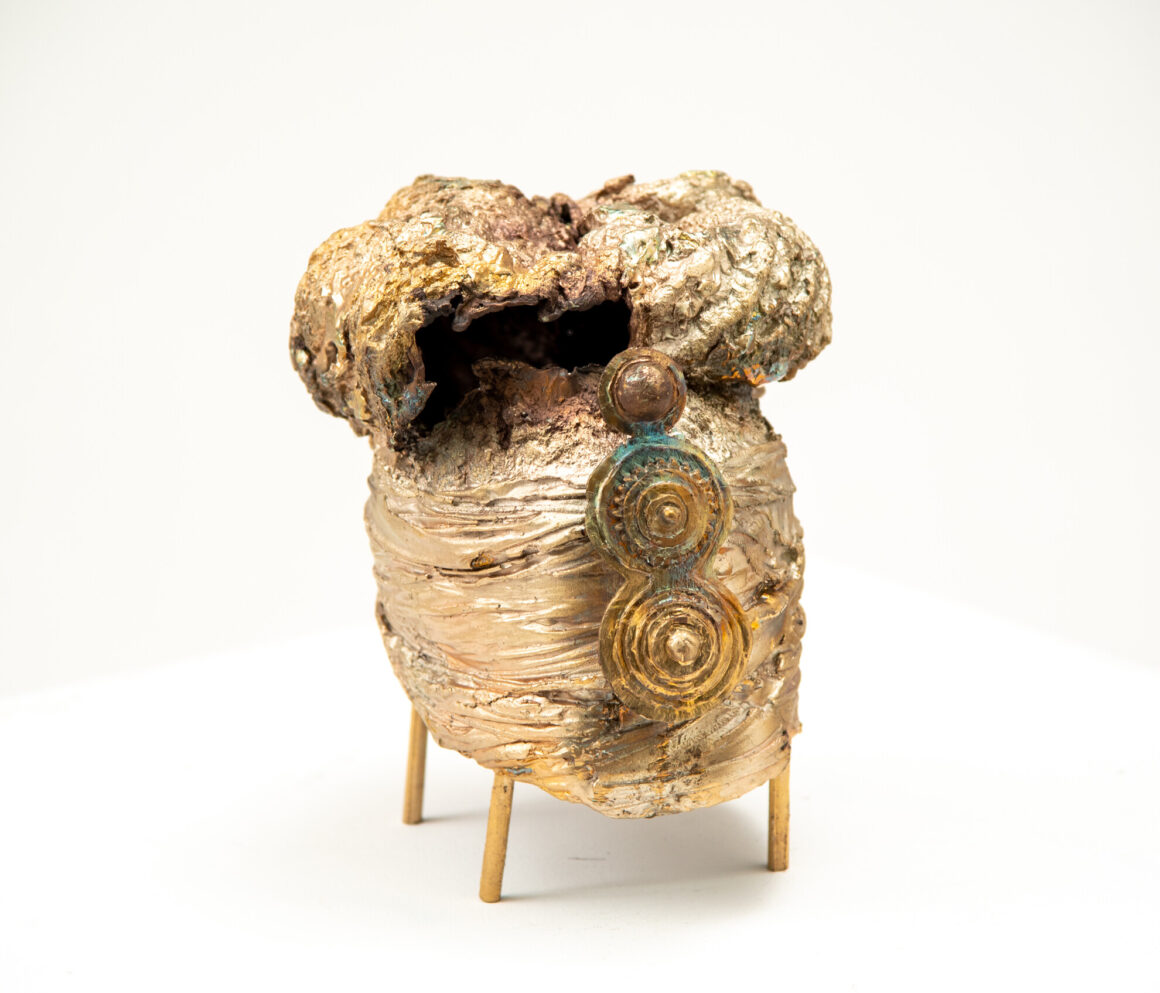
2020, bronze. ©The Artist. Cultural Collections and Galleries, University of Leeds Libraries, Art Collection.
Kedisha Coakley moved from London to Sheffield in 2009. Her sculpture, photography and prints invite the viewer on a journey inspired by African and Caribbean cultures, childhood memories, symbols and spiritual iconography, re-examining and reinterpreting social and historical narratives. Rooted in ancient traditions, Truth II is part of Coakley’s ‘Ritual’ series and explores the intimate acts of caring for her own Afro hair.
The exhibition features works by Wendy Abbott, Terry Atkinson, Simeon Barclay, David Blackburn, Jim Brook, Francis Butterfield, Tony Carter, Grace Clifford, Kedisha Coakley, Joanne Coates, Dennis Creffield, Charlotte Saint Cullen, Charlotte Dawson, George Storm Fletcher, Terry Frost, Thomas Griffiths, Will Hughes, Sam Hutchinson, Mia Jones, Arthur Kitching, Mary Lord, Jill McKnight, Sam Metz, Henry Moore, Philip Naviasky, Joseph Pighills, Conor Rogers, Lydia Shearsmith, Connor Shields, Beth Smith, Bethany Stead, Norman Stevens, Maud Sulter, Harry Thubron, Lucy Wright, Ajamu X.

c.1968-73, oil on board © Estate of the Artist. Cultural Collections and Galleries, University of Leeds Libraries, Art Collection.
Born into a working-class family in Sheffield, Arthur Kitching (1912-1981) was largely self-taught. He took evening classes at Sheffield College of Art and gained entrance to the Royal College of Art, but couldn’t afford the fees.
Wrestling has been a subject in art since ancient Greece. In Britain it became a form of working-class theatre in the tradition of the circus and the music hall, and from 1955 it could be seen on television. Kitching was a known wrestling fan, and this painting is informed by the overhead perspective of the TV cameras, the sport’s bold advertising posters and ideas borrowed from vorticism and Matisse.
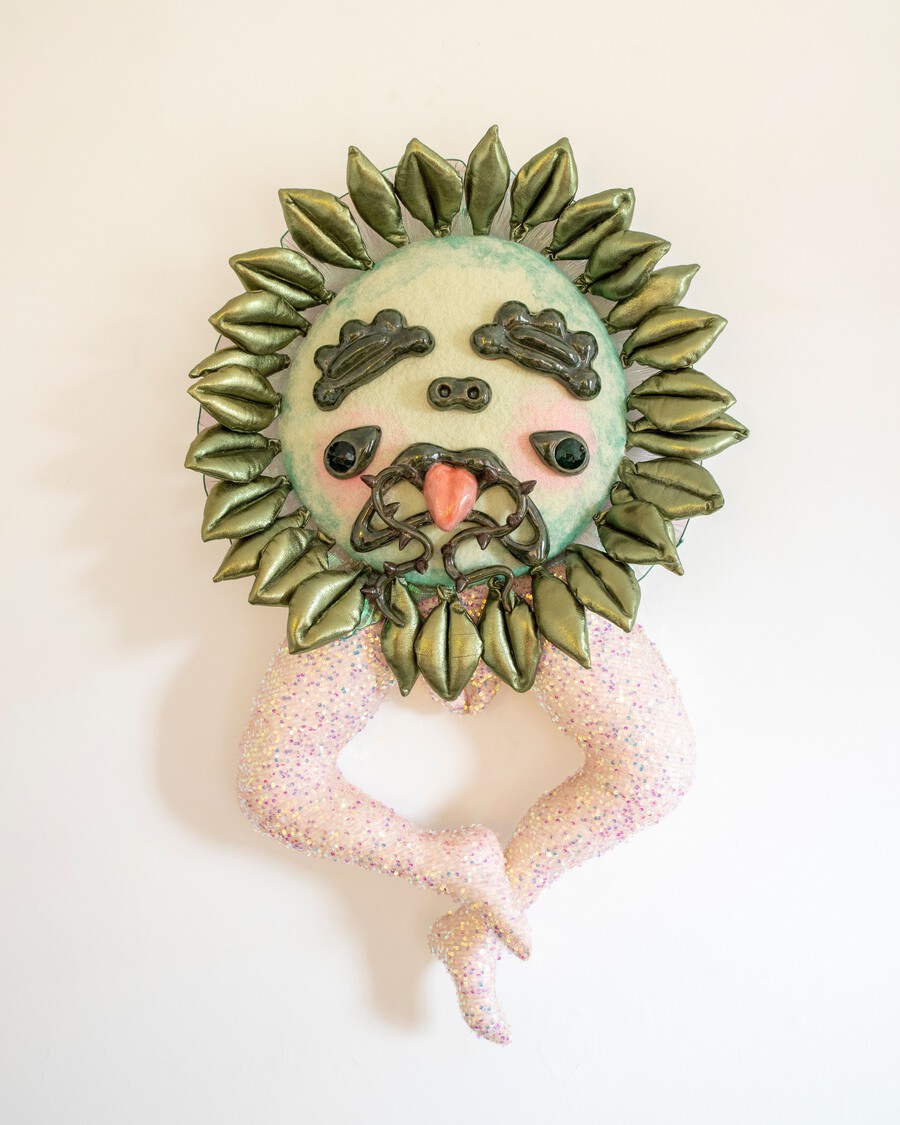
2024, felt, glazed ceramics and sequin mesh fabric © The Artist.
Leeds-based artist Lucy Wright’s practice sits at the intersection of folklore and activism, often using her extensive research into lesser-known contemporary and female-led folk customs as source material. Her work is concerned with exploring folk as an agent for resistance and change—speaking to the culture we create for ourselves and its radical potential.
The Stanley & Audrey Burton Gallery, University of Leeds.
Continues until 6th June 2026.
Photography by Mark Webster, University of Leeds.