War of the Worlds: Visually inventive, hauntingly gripping – a once-in-a-life-time piece of theatre.
It’s rare to encounter a piece of theatre that genuinely feels like something entirely new, but War of the Worlds at Leeds Playhouse is exactly that. And that’s not said lightly. Having seen a great deal of theatre across styles and scales, this stands apart as a truly original experience: an incredibly clever, slick, and meticulously crafted production that integrates live film-making in a way that feels both seamless and astonishing. What could so easily have become a technical gimmick instead becomes the very heartbeat of the piece, elevating the storytelling rather than distracting from it.
Created and directed by Simon Wainwright, Pete Brooks and Andrew Quick with their company ‘Imitating the Dog’ and performed by a cast of just four (Bonnie Baddoo, Morgan Bailey, Gareth Cassidy and Amy Dunn) this is very much a company-authored piece in the truest sense. The aesthetic is shaped as much by its visual language as its direction, with video design playing a central role. The result is theatre that feels collaborative at its core; where performance, direction, design and technology are inseparable.
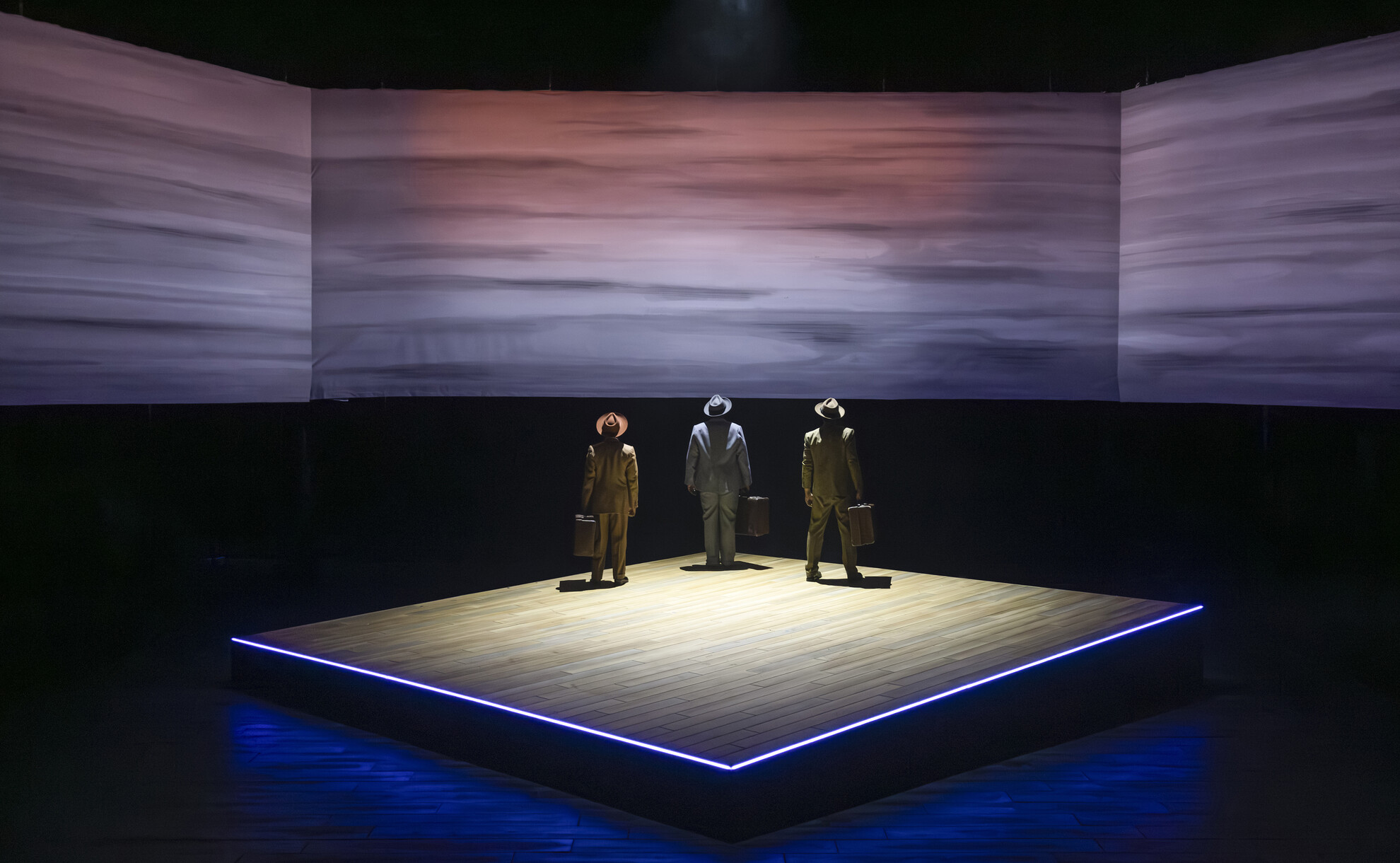
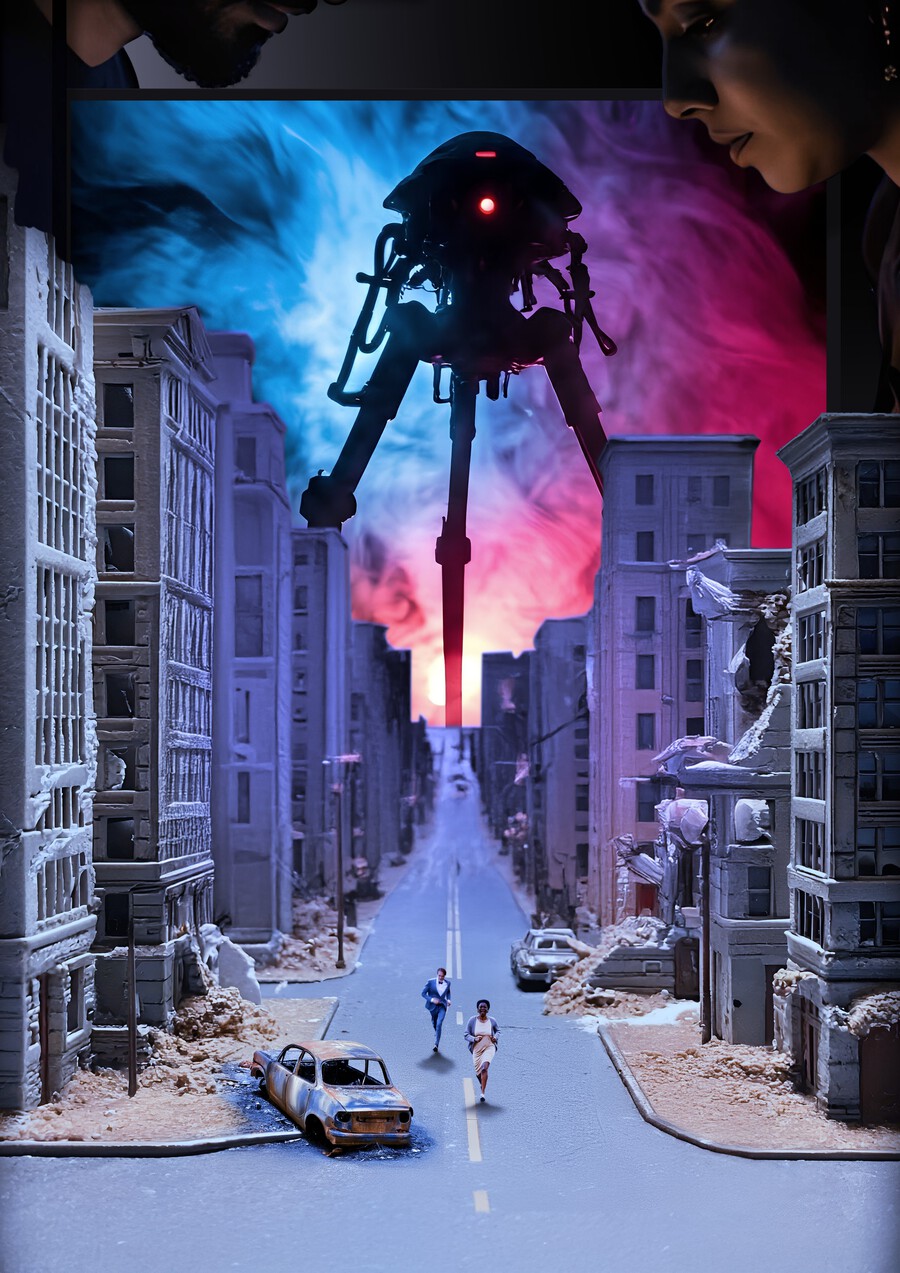
What’s most striking is how effortlessly the live performance and filmed elements coexist. Using onstage cameras, miniature models, and cleverly constructed sets, the performers build a kind of live film in front of the audience. We are constantly aware of the mechanics, watching scenes being shot, props manipulated, worlds constructed, while simultaneously seeing the polished, projected version in real time. It creates a thrilling dual perspective: both the illusion and its making. There’s something deeply satisfying about being let in on the trick while still being completely swept up in it. It’s inventive, audacious theatre-making that never loses its sense of play.
For those less familiar with the story, War of the Worlds is based on the novel by H. G. Wells, charting a devastating alien invasion of Earth. Society rapidly collapses as humanity is confronted with a force far beyond its control. This adaptation leans into the human perspective: fear, survival, moral compromise and the fragility of civilisation. Rather than focusing purely on spectacle, it interrogates how people behave when everything familiar is stripped away: what we cling to, what we abandon, and what we become when survival is no longer guaranteed. This particular adaptation is told in a way which instantly made me think if the film ‘28 Days Later’, an end-of-the-world post-apocalyptic show that is hauntingly disturbing.
Crucially, the performances never get lost within the technical brilliance. In a production so heavily reliant on film, it would have been easy for the acting to take second place, but the opposite is true. The cast deliver work of remarkable precision and clarity. Bonnie Baddoo and Morgan Bailey are particularly outstanding in their ability to multirole with such fluency, creating distinct, fully realised characters without the aid of costume changes. Their physical and vocal transformations are so sharp that each new character feels immediate and unmistakable. Bailey’s manic military figure is a standout: both deeply unsettling and unexpectedly hilarious, eliciting one of the most explosive and memorable laughs I’ve heard in a theatre. Meanwhile, Gareth Cassidy and Amy Dunn provide equally assured, detailed work as the man characters, anchoring the production with consistency and control amidst its technical complexity.
The design elements obviously deserve equal praise. The use of scale, with miniature buildings showing carefully crafted environments, combined with live-feed projection, creates moments of surprising cinematic grandeur within the intimate Courtyard space. Lighting and sound work in perfect harmony with the visuals, building an atmosphere that is at once tense, eerie and at times darkly comic. It feels less like watching a play and more like witnessing a piece of theatre being constructed in front of you, layer by layer, moment by moment.
Beyond its technical and performative achievements, the production carries a resonant thematic weight. By situating the story in the 1960s, in the aftermath of the “Rivers of Blood” speech, it draws a pointed parallel between the fear of invasion and attitudes towards immigration. The suggestion that a society can lose its instinct to help those in need, particularly those fleeing war-torn countries, feels uncomfortably relevant to today’s world. It’s a perspective that lingers long after the final moments, prompting reflection on how little some of these attitudes have shifted.
This is theatre that doesn’t just impress in the moment; it endures. Visually inventive, intellectually engaging, and anchored by exceptional performances, it’s a piece that will stay with you for a very long time.
leedsplayhouse.org.uk/event/war-of-the-worlds/